
Recall
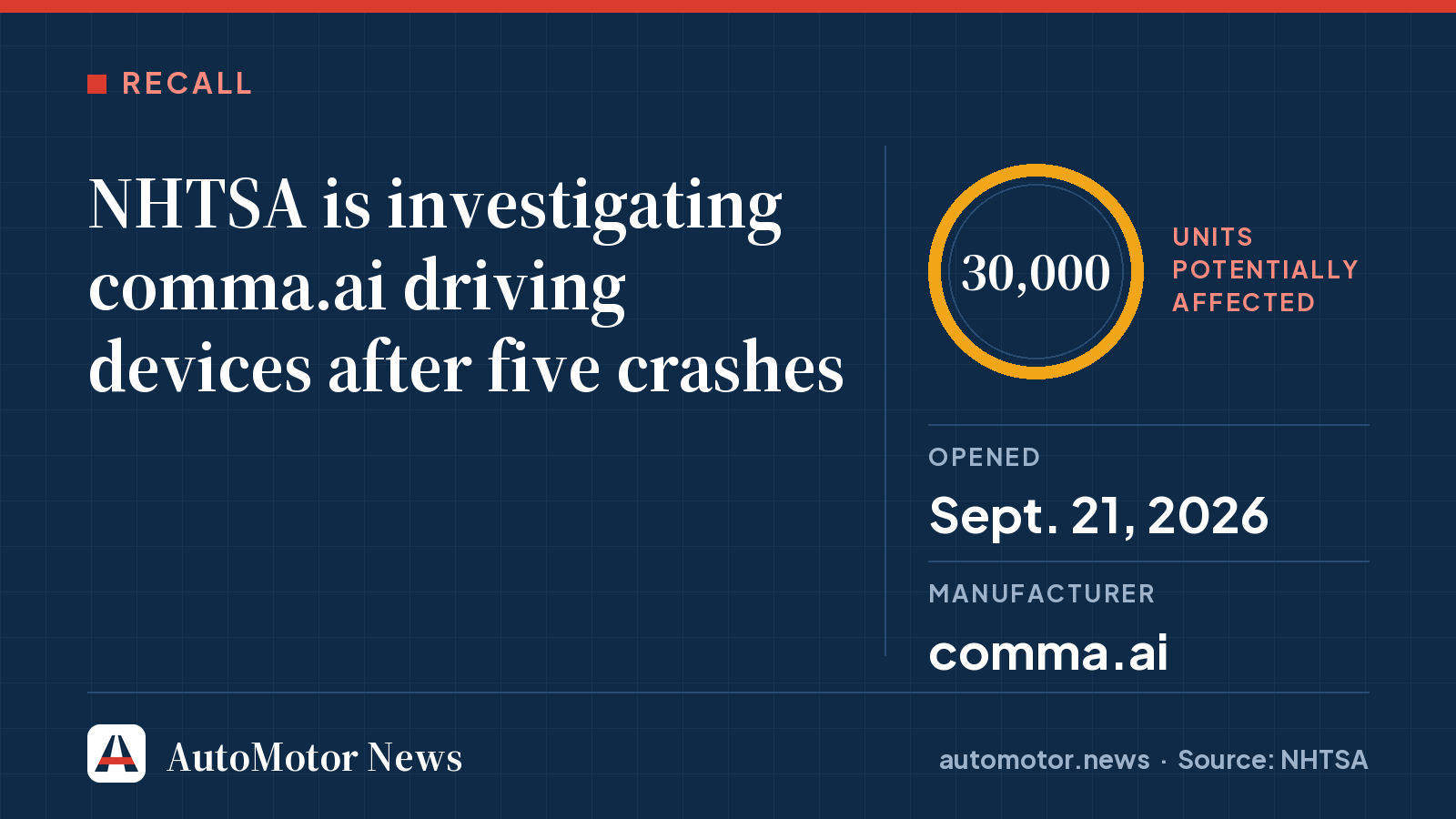
NHTSA is investigating comma.ai driving devices after five crashes
PE26007, opened Sept. 21, 2026, covers the after-market comma 3X, comma four and comma three; two of the five reported crashes resulted in three deaths, and NHTSA's investigation record lists no recall.
Checked against 2 sources (2 primary)Records from nhtsa.gov · How we report

Published · 4 min read
Key numbers
Units potentially affected as filed with NHTSA
Jump to
Is your car affected?
For open (unrepaired) recalls on your car, enter its 17-character VIN in NHTSA's lookup by VIN.
Recall at a glance
- Investigation
- Preliminary Evaluation PE26007 [1]
- Opened
- Sept. 21, 2026 [1]
- Products named in the investigation
- comma 3X, comma four, comma three (after-market driving automation devices) [1]
- Estimated population (NHTSA)
- 30,000 (estimated), across the comma three, comma 3X, comma four and openpilot; an estimate of the products' population, not a count of affected cars [2]
- Manufacturer
- comma.ai [1]
- Subject (NHTSA's wording)
- Crashes involving comma.ai driving automation products [1]
- Crashes cited
- Five, in which vehicles with comma devices installed reportedly struck stopped or slowly moving vehicles within the same travel lane [1]
- Deaths
- Three, in two crashes [1]
- Injuries
- 11 other people, including serious injuries, in four of the five crashes [1]
- Recall
- None listed in NHTSA's investigation record [1]
- Status
- No closing date listed in NHTSA's record as of Oct. 28, 2026 [1]
| Make | Model | Model years | Units |
|---|---|---|---|
| comma.ai | comma 3X (after-market driving automation device) | No model year listed (after-market device) | Not stated |
| comma.ai | comma four (after-market driving automation device) | No model year listed (after-market device) | Not stated |
| comma.ai | comma three (after-market driving automation device) | No model year listed (after-market device) | Not stated |
| comma.ai | All listed products combined (comma three, comma 3X, comma four, openpilot): NHTSA's estimated population, no per-product split; not a count of affected cars | No model year listed (after-market device) | 30,000 |
What to do
NHTSA's summary quotes comma's website as stating that "openpilot requires the driver to be alert, pay attention, and be ready to take over at all times."
If you drive a car with a comma device installed, stay alert, pay attention and be ready to take over at all times, as that warning says.
If you are buying a used car that has a comma device installed, ask the seller which device and which software it runs.
NHTSA lists the crash reports it cites by SGO report ID: 30351-15888, 30351-14668, 30351-11961, 30351-1807 and 62-14853. NHTSA says they are available for download at NHTSA.gov/laws-regulations/standing-general-order-crash-reporting.
What happened
The National Highway Traffic Safety Administration (NHTSA) opened Preliminary Evaluation PE26007 on Sept. 21, 2026. The investigation covers driving automation devices made by comma.ai: the comma 3X, comma four and comma three.
NHTSA's Office of Defects Investigation (ODI) says it has identified crashes under similar circumstances involving vehicles equipped with comma devices.
ODI received notice of five crashes in which vehicles with comma devices installed reportedly struck stopped or slowly moving vehicles within the same travel lane.
Two of the crashes resulted in a total of three deaths. Four of the five crashes contributed to non-fatal injuries, including serious injuries, to 11 other people.
ODI says it has confirmed that the systems were powered on or engaged in multiple crashes. Preliminary data reviewed by ODI suggests that the comma system may not have adequately detected or responded to the in-lane vehicles.
ODI opened the Preliminary Evaluation to investigate further any incidents involving the comma devices and openpilot, the software comma develops for them, particularly crashes involving slower or stopped vehicles or hazards in lane.
The investigation will obtain data to verify system status for each incident. It will also evaluate system performance and the safeguards intended to ensure safe operation of vehicles equipped with comma devices.
If modified software based on openpilot, known as a fork, is involved in a crash or other incident, ODI will evaluate the incident and consider the components openpilot and the fork share.
NHTSA's subject line for the investigation is "Crashes involving comma.ai driving automation products."
Is my car affected?
PE26007 covers comma devices, not a car model. NHTSA's record lists three products: the comma 3X, comma four and comma three.
NHTSA's opening resume for PE26007 lists the products as the comma three, comma 3X, comma four and openpilot, and gives their population as 30,000 (estimated). That is NHTSA's estimate of the products' population across all four listed products, not a count of affected cars; NHTSA gives no per-product split.
NHTSA describes the devices as after-market accessory systems intended to augment a vehicle's driving automation capabilities.
According to NHTSA, the devices are sold with wire harnesses that connect to existing vehicle systems. NHTSA says they use the device's cameras alongside stock vehicle sensors as a basis to provide sustained automated control of speed and vehicle heading.
The devices are sold directly to consumers, and comma's setup instructions are intended for consumer installation, NHTSA says.
NHTSA's summary quotes comma's website as saying that, with its "step-by-step guide," a consumer can "[g]et set up in your car in 15 minutes."
As NHTSA quotes it, comma's website says the devices provide "hands free driving for the car you already have" and describes openpilot as "an open source advanced driver assistance system that works on 325+ car models" that "[c]an drive for hours without intervention."
NHTSA's investigation record lists no recall for these devices, and it gave no closing date for PE26007 when we checked it on Oct. 28, 2026.
Enter your 17-character VIN in our free recall check at /vin-check/ or on NHTSA.gov.
New NHTSA vehicle recalls: Recall tracker
This story was prepared with AI assistance and fact-checked by our AI review process against its sources, then reviewed by Paul Grice before publication. Our AI policy.
Sources
All 2 are primary sources, accessed 2026-10-28.