
Guide
How to check a used car for recalls before you buy
Federal law lets dealers sell used cars with open recalls, and on seven used models we found recalls filed eight or more years after the model year.
Checked against 18 sources (17 primary)

Last updated · Updated · 11 min read
Quick answer
Before you pay, enter the car's 17-character VIN in the automaker's recall lookup or on NHTSA.gov.
A clean result only means no open recall was found, and a recall newer than the lookup's last weekly update can be missing.
The repair is free unless the first buyer bought the car more than 15 calendar years before the recall notice (five years for tires).
Federal law does not stop dealers from selling used cars with open recalls, so the check is yours to make.
At a glance
| Item | Detail | Source |
|---|---|---|
| Free recall repair: age limit | Not owed if the first buyer bought the car more than 15 calendar years before the recall notice or an NHTSA recall order, whichever is earlier (tires: 5) | [5] |
| Federal ban on selling with an open recall | New cars and covered rental cars; not used cars on dealer lots | [5] |
| Automaker VIN lookups: how far back | At least the past 15 calendar years of recall campaigns | [1] |
| Automaker VIN lookups: how often updated | At least once every 7 calendar days | [1] |
| Vehicle recall campaigns on seven used models, model years 2010-2024 | 296 distinct campaigns across 102 model years | [17] |
| Most campaigns on one model year, in our data | 23 (2020 Ford Escape) | [14] |
| 2010-2014 recall listings filed 8+ years after model year | 32 of 196 (16.3%), a minimum | [17] |
| Campaigns with do-not-drive or park-outside advice | 7 of 296 (5 on the Hyundai Tucson) | [17] |
Steps to check a used car for recalls before you buy
- Find the VIN. On a car, SUV or light truck, stand outside next to the driver's-side windshield pillar and read the VIN through the windshield; it is inside the car.
- Read it carefully. A VIN has 17 characters and never uses the letters I, O or Q.
- Compare it with the VIN on the title and registration before you rely on any lookup.
- Enter it in the automaker's recall lookup, linked from its main US website, or search it on NHTSA.gov to see which recalls are still open on this car. Note the last-update date and the earliest date covered.
- Then enter it in our free check to see every recall for that make, model and year.
- If a recall you expected is missing, ask the seller for the dealer repair order that shows it was done. The automaker's lookup must also tell you how to contact the automaker with questions.
- If a recall is open, ask the seller to have it fixed before you pay, or put the promise in the written sale terms.
- If it is still open after you buy, take the car to a dealer for that brand. Under federal law, the repair is free unless the first sale was more than 15 calendar years before the recall notice.
- If the recall record says to park outside or not to drive, follow it until the repair is done. In our data, seven of the 296 campaigns carry that advice; they are listed below under the seven models.
- After you buy, register the car in your name and open any envelope marked "SAFETY RECALL NOTICE."
Recalls on seven used models, by model year
We counted the vehicle recall campaigns NHTSA lists for seven used models: the Toyota RAV4, Honda CR-V, Mazda CX-5, Ford Escape, Hyundai Tucson, Jeep Grand Cherokee and Nissan Rogue. A campaign is one recall filed with NHTSA under its own number, such as 23V-651. That is 102 model years, 2010 through 2024, with the CX-5 from 2013.
Together they carry 296 distinct vehicle recall campaigns. The 2020 Ford Escape has the most for one model year, 23, followed by the 2023 Jeep Grand Cherokee with 21.
NHTSA lists 78 campaigns across the Grand Cherokee's 15 model years and eight across the CX-5's 12, and five model years have none: the 2020 through 2024 CX-5.
These are raw counts, not rates, and they are not adjusted for how many cars were sold. A campaign can also cover only some cars of a model year: Honda's frame-corrosion recall 23V-228 covers certain 2007-2011 CR-Vs sold or ever registered in 22 states and the District of Columbia. Use a high count as a list of recalls to ask about; only a VIN lookup shows whether a given car has one open.
For a model-by-model view, our guides page, automotor.news/guides/, lists a years-to-avoid guide for each of the seven. To find your model year here, download recalls_by_model_year.csv, which links each of the 102 model years to its NHTSA query; recall_listings.csv names every campaign.
Seven of the 296 campaigns carry NHTSA advice to park outside or not to drive until the repair is done. Five are Hyundai Tucson campaigns, and together they reach every Tucson model year from 2010 through 2024; our Hyundai Tucson years-to-avoid guide covers that model. The seven, with the part NHTSA lists:
- 12V-336: 2013 Ford Escape; fuel system hoses, lines and fittings.
- 23V-651: 2010-2013 Hyundai Tucson; anti-lock brake control unit.
- 22V-056: 2014-2015 Hyundai Tucson; anti-lock brake control unit.
- 20V-543: 2016-2021 Hyundai Tucson; anti-lock brake control unit.
- 25V-893: 2022-2024 Hyundai Tucson; trailer hitches.
- 23V-526: 2023-2024 Hyundai Tucson; automatic transmission fluid pump.
- 25V-741: 2022-2024 Jeep Grand Cherokee 4xe (plug-in); traction battery.
Model years with the most vehicle recall campaigns, seven used models, 2010-2024
Show the data
| Model year | Vehicle recall campaigns |
|---|---|
| 2020 Ford Escape | 23 |
| 2023 Jeep Grand Cherokee | 21 |
| 2021 Ford Escape | 19 |
| 2022 Ford Escape | 19 |
| 2013 Ford Escape | 18 |
| 2014 Jeep Grand Cherokee | 18 |
| 2014 Ford Escape | 16 |
| 2024 Jeep Grand Cherokee | 16 |
| 2010 Honda CR-V | 15 |
| 2010 Toyota RAV4 | 14 |
| 2011 Honda CR-V | 13 |
| 2022 Jeep Grand Cherokee | 13 |
Distinct vehicle recall campaigns per model, model years 2010-2024
Show the data
| Model | Distinct vehicle recall campaigns |
|---|---|
| Jeep Grand Cherokee | 78 |
| Ford Escape | 72 |
| Nissan Rogue | 41 |
| Honda CR-V | 39 |
| Toyota RAV4 | 38 |
| Hyundai Tucson | 20 |
| Mazda CX-5 | 8 |
Recalls keep arriving as cars age
For the 2010 through 2014 model years, we measured how long after the model year each recall arrived: the year NHTSA received the defect report minus the model year. A result of -1 means the report came in the calendar year before the model year.
Here we count listings: a listing is one campaign on one model year. The 2010 through 2014 model years carry 196 listings from 119 distinct campaigns.
Of those 196 listings, 32 (16.3 percent) came eight or more years after the model year, and 10 came 10 or more years after. Both are minimums: 2026 is a partial year, with data through Oct. 12, 2026, and later reports can still add to them.
In 2023, Hyundai's anti-lock brake recall 23V-651 reached the 2010 Tucson, 13 years after its model year. NHTSA's record tells owners to park outside and away from structures until the repair is done, and says dealers will replace the ABS fuse free of charge.
Honda's 23V-228 frame recall also came 13 years after the 2010 CR-V. Ford's engine block heater recall 26V-011, filed in January 2026, reached certain 2013 Escapes with the 2.0L engine 13 years after their model year.
Model year is only a stand-in for age. The free-repair limit runs from the first buyer's purchase to the recall notice, not from the model year (see "Free recall repairs and the 15-year limit"). So an older car is not past recall risk. Run the VIN lookup again right before you pay, and register the car in your name so later notices reach you.
When recalls arrived on 2010-2014 model years, by years after the model year
Show the data
| Years after model year | Recall listings |
|---|---|
| -1 | 8 |
| 0 | 34 |
| 1 | 27 |
| 2 | 24 |
| 3 | 22 |
| 4 | 12 |
| 5 | 13 |
| 6 | 15 |
| 7 | 9 |
| 8 | 13 |
| 9 | 9 |
| 10 | 3 |
| 11 | 1 |
| 12 | 3 |
| 13 | 3 |
What a clean recall lookup can and cannot tell you
A federal rule, 49 CFR 573.15, sets what an automaker's online recall lookup must do. It applies to automakers that made, sold or imported 25,000 or more light vehicles or 5,000 or more motorcycles for the US this calendar year or last. A small car maker does not have to offer a lookup.
The rule also requires automakers to send this data to NHTSA for display on its websites.
The lookup must be free, and it cannot make you register or give anything beyond the make, model and VIN. A result must list each recall not completed on that VIN. For each one it must give NHTSA's campaign number, the date the defect was reported, a short description of the defect and its safety risk, and the remedy. It must also state the earliest date its records cover.
What a clean result does not tell you:
- Recalls already repaired. The lookup lists only recalls not yet completed on that car, so it cannot serve as a repair history.
- Older campaigns. The lookup must include at least the previous 15 calendar years of owner notification campaigns, so recalls whose owner notification began more than 15 calendar years ago may not appear. On an older car, check the earliest date the lookup says it covers.
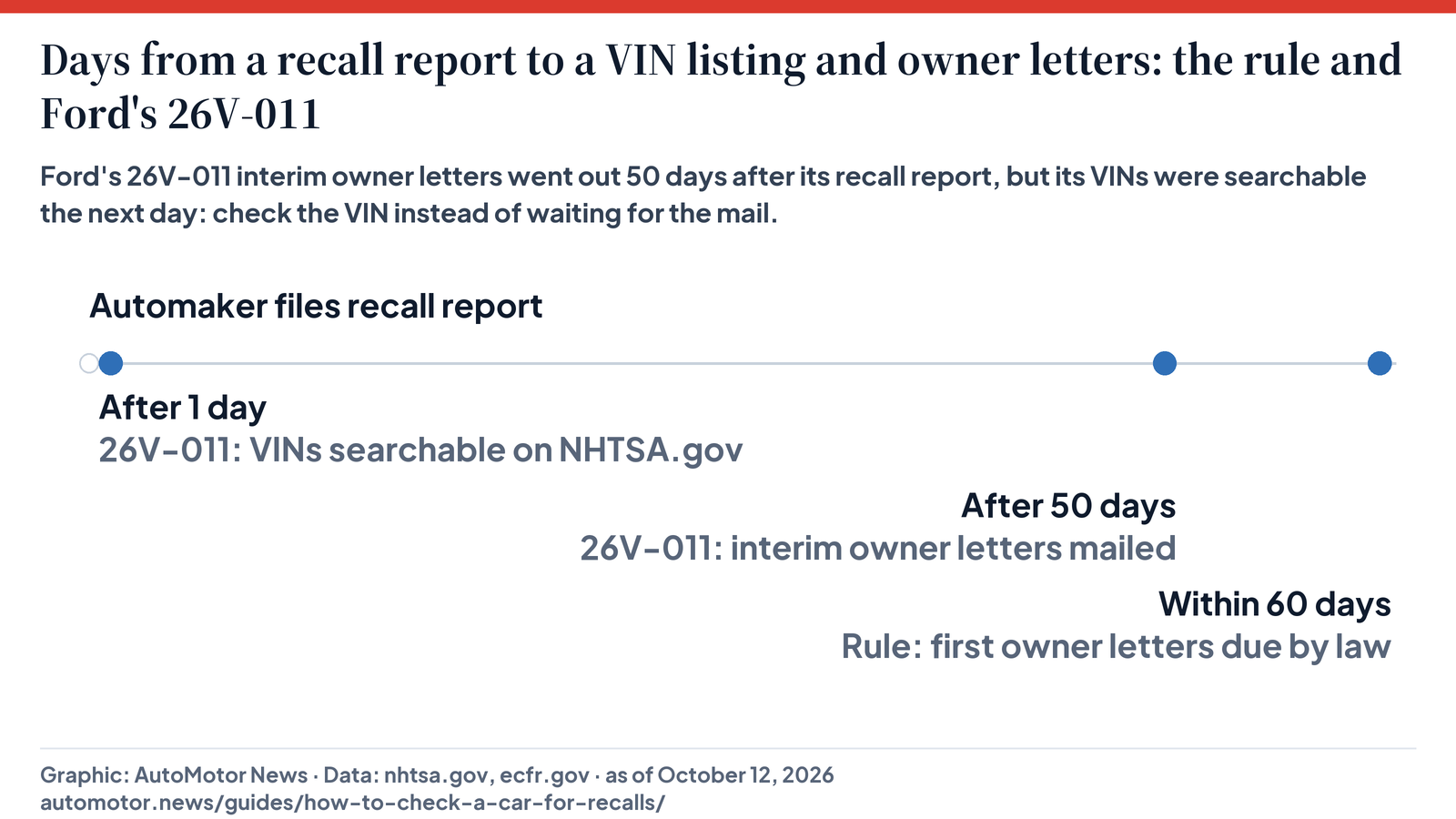
- The newest recalls. The lookup must be updated at least once every seven calendar days and show the date of its last update, so a very new recall can be missing until the next update. The lag can be short: for Ford's 26V-011, NHTSA's record says the affected VINs became searchable on NHTSA.gov on Jan. 16, 2026, the day after the report.
- Recalls on replacement parts from other companies, such as glass. The lookup covers recall information on the vehicles the automaker made, so a recall on another company's replacement part may not appear. NHTSA's recall list for the 2016 CX-5, from its recallsByVehicle data rather than a VIN lookup, includes a windshield campaign, 16E-002, filed by Pilkington North America, not Mazda.
- Accident, title-brand or mileage records. The rule covers safety recall information only, so do not expect them from a recall lookup.
Days from a recall report to a VIN listing and owner letters: the rule and Ford's 26V-011
Ford's 26V-011 interim owner letters went out 50 days after its recall report, but its VINs were searchable the next day: check the VIN instead of waiting for the mail.
Free recall repairs and the 15-year limit
When a recall is required, federal law says the automaker must fix the defect without charge when the vehicle is presented for the remedy. The recall letter must say whether the remedy will be a repair, a replacement or a refund of the purchase price, less depreciation for a vehicle. For a repair, the letter must give the automaker's estimate of the labor time.
There is one age limit. The free fix is not owed if the car's first buyer bought it more than 15 calendar years before the recall notice or NHTSA's recall order, whichever came first. Pub. L. 114-94, enacted Dec. 4, 2015, raised the limit from 10 to 15 calendar years. For tires, the limit is five calendar years.
The test looks back from the date of the recall notice, not from the day you buy the car or bring it in. If a car's first sale was 14 calendar years before a recall notice, that recall falls inside the limit, whatever the car's age when you buy it.
If you believe the automaker or its dealer has failed or is unable to fix the defect free or within a reasonable time, you can complain to NHTSA, including on its Vehicle Safety Hotline, 1-888-327-4236. For a non-tire repair, a reasonable time is no more than 60 days after you first bring the car in on or after the letter's repair start date, unless NHTSA extends it.
If the automaker's repair is not done adequately within a reasonable time, federal law says the automaker must do one of two things. It must replace the vehicle free with an identical or reasonably equivalent vehicle, or refund the purchase price, less a reasonable allowance for depreciation. Under that law, failing to repair the car adequately within 60 days after it is presented is prima facie evidence of failing to repair it within a reasonable time.
How our free VIN check works
Our free check at automotor.news/vin-check/ decodes the VIN with vPIC, NHTSA's VIN decoder.
It then lists every NHTSA recall for the vehicle's make, model and year. Not every one may apply to that exact car, and some may already have been repaired.
Confirm open recalls on the automaker's lookup or NHTSA.gov; a listed recall missing there may be repaired, not apply, or fall in a gap under "What a clean recall lookup can and cannot tell you."
We don't store, log or share the VINs you check.
Frequently asked questions
Can a dealer sell a used car with an open recall?
Yes, under federal law. The federal sale limit, 49 USC 30120(i), names only dealers holding new vehicles and rental companies holding covered rental vehicles, and does not name private sellers. The FTC has said federal law does not prohibit dealers from selling used cars with open recalls, while state consumer protection and other laws give buyers of defective cars their own safeguards.
Can a dealer advertise a used car as inspected if a recall is open?
Not in a way that hides the recall: the FTC says federal law lets it stop car sellers from false or misleading advertising that masks the existence of open recalls. It has issued orders against six companies: General Motors, Jim Koons Management and Lithia Motors (December 2016), and CarMax, Asbury Automotive Group and West-Herr Automotive Group (March 31, 2017). Those orders barred safety claims, such as touting rigorous inspections, unless the cars were free of open recalls or the seller clearly disclosed that they might have open recalls and how to check.
Does a recall stay with the car when it is sold?
Yes: recall letters name the VIN they apply to, and the law ties the free fix to the vehicle being presented for the remedy. After a sale, automakers mail recall notices to the owner registered under state law whose name and address they can reasonably find through state records or other sources. Recall letters to owners are due no later than 60 days after the automaker files its defect report.
What if the lookup says the remedy is not yet available?
The car is covered by the recall, but no fix exists yet; the lookup must say so. The automaker must send a second notice once the remedy is available. For Ford's 26V-011, interim letters went out on March 6, 2026, and owners are advised not to plug in the block heater until the vehicle is remedied.
New NHTSA vehicle recalls: Recall tracker. Recalls NHTSA marks do not drive or park outside: Do-not-drive and park-outside recalls
Last updated .
This story was prepared with AI assistance and fact-checked by our AI review process against its sources, then reviewed by Paul Grice before publication. Our AI policy.
Sources
All accessed 2026-10-12.
- 49 CFR 573.15: Public availability of motor vehicle recall information (eCFR) (primary source).
- 49 CFR 565.13: VIN general requirements (eCFR) (primary source).
- 49 CFR 577.5: Notification pursuant to a manufacturer's decision (eCFR) (primary source).
- 49 CFR 577.7: Time and manner of notification (eCFR) (primary source).
- 49 U.S.C. 30120: Remedies for defects and noncompliance (LII, Cornell Law School) (primary source).
- AutoMotor News: Free VIN and recall check (our tool page).
- FTC: Final orders settling charges that used auto dealers touted inspections without disclosing unrepaired safety recalls (March 31, 2017) (primary source).
- FTC: Statement of the Commission concerning auto recall advertising cases (Dec. 15, 2016) (primary source).
- NHTSA recalls API, recallsByVehicle (one query per model and model year; example: 2010 Hyundai Tucson) (primary source).
- NHTSA recall 23V-651 (Hyundai anti-lock brake module), campaign record (primary source).
- NHTSA recall 23V-228 (Honda CR-V frame corrosion), campaign record (primary source).
- NHTSA recall 26V-011 (Ford engine block heater), campaign record (primary source).
- NHTSA recalls API, recallsByVehicle: 2016 Mazda CX-5 (primary source).
- AutoMotor News data: vehicle recall campaigns per model and model year, seven models, 2010-2024 (recalls_by_model_year.csv) (our analysis of source 9 and source 13).
- AutoMotor News data: recalls on 2010-2014 model years by years after the model year (recall_age.csv) (our analysis of source 9 and source 13).
- AutoMotor News data: every vehicle recall listing behind our counts (recall_listings.csv) (our analysis of source 9 and source 13).
- AutoMotor News data: totals behind this page (recall_summary.csv) (our analysis of source 9 and source 13).
- NHTSA recall 25V-741 (Jeep Wrangler 4xe and Grand Cherokee 4xe high-voltage battery), campaign record (primary source).