
Guide
Ford Escape years to avoid: 2013-14, 2017-18 and 2020 in NHTSA data
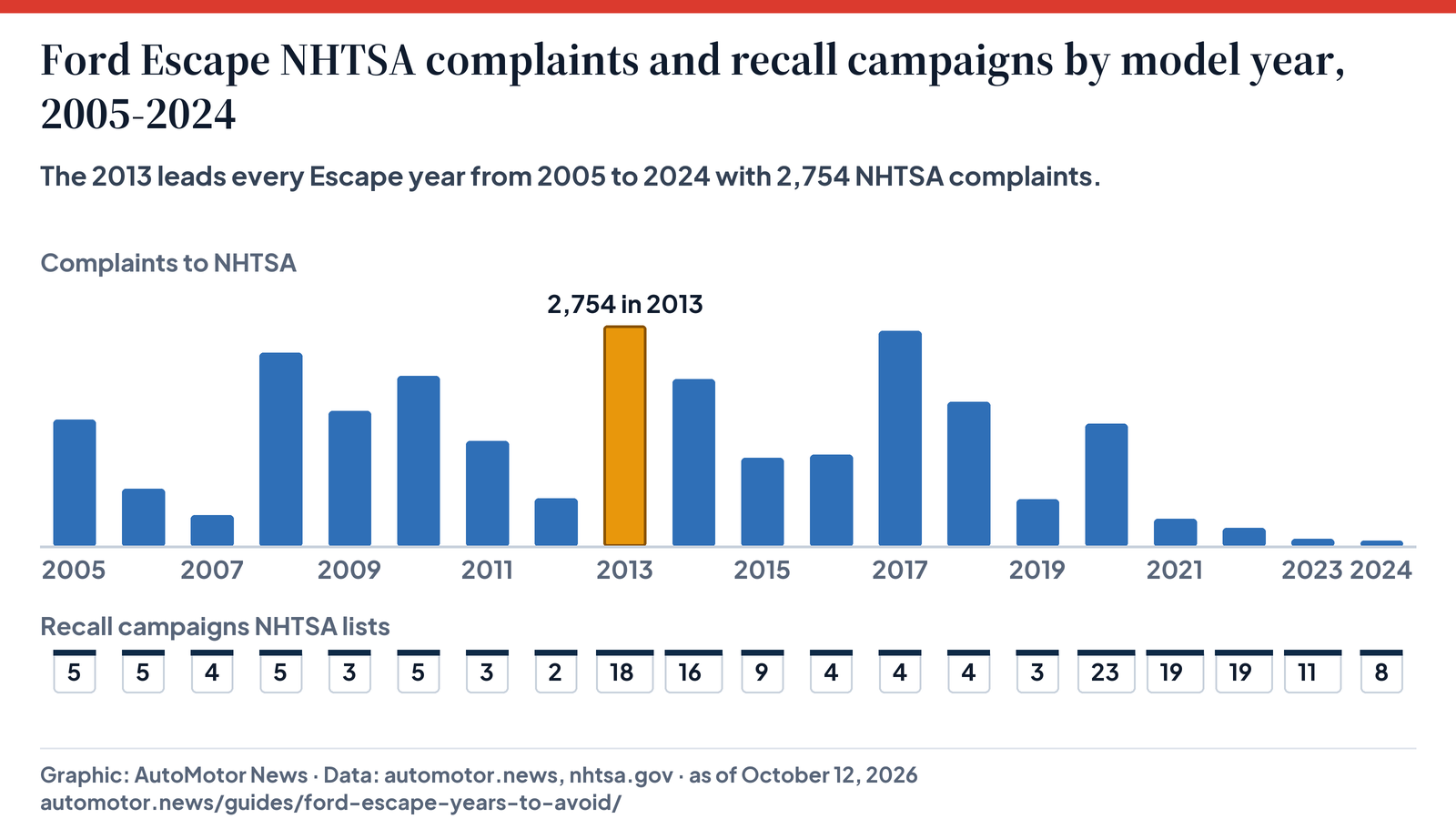
The 2014 Escape has the most NHTSA crash or fire reports, the 2017 the most complaints since Oct. 12, 2024, and the 2020 the most recall campaigns. Check the VIN for open recalls before you buy.
Checked against 41 sources (41 primary)

Last updated · Updated · 21 min read
Highest year in amber. Every year, with sources · Download this chart (PNG)
Quick answer
Check the 2013-2014, 2017-2018 and 2020 Escapes hardest: the 2014 leads in crash or fire reports, the 2017 in recent complaints, the 2020 in recall campaigns. The 2013-2014 carry 1.6-liter fire recalls; most 2017-2018 complaints since Oct. 12, 2024 mention coolant. Since Oct. 12, 2024 the 2023 and 2024 drew 70 and 74 complaints, fewer than any 2013-2022 year. That window is fairer than totals but not adjusted for how many of each year remain on the road; no year is free of complaints or recalls.
At a glance
-
Most complaints
2,754Model year: 2013
complaints to NHTSA [29]
-
Fewest complaints
76Model year: 2024
complaints to NHTSA [29]
-
Most recall campaigns
23Model year: 2020
recall campaigns [29]
| Model year | Complaints to NHTSA | Recall campaigns | Crash or fire reported | New reports since Oct. 12, 2024 |
|---|---|---|---|---|
| 2024 | 76 | 8 | 5 | 74 |
| 2023 | 100 | 11 | 5 | 70 |
| 2022 | 234 | 19 | 11 | 151 |
| 2021 | 349 | 19 | 18 | 184 |
| 2020 | 1,533 | 23 (highest) | 24 | 533 |
| 2019 | 594 | 3 | 27 | 317 |
| 2018 | 1,806 | 4 | 30 | 876 |
| 2017 | 2,691 | 4 | 53 | 1,063 (highest) |
| 2016 | 1,146 | 4 | 47 | 437 |
| 2015 | 1,110 | 9 | 48 | 353 |
| 2014 | 2,088 | 16 | 150 (highest) | 263 |
| 2013 | 2,754 (highest) | 18 | 139 | 153 |
| 2012 | 603 | 2 | 40 | 33 |
| 2011 | 1,317 | 3 | 45 | 64 |
| 2010 | 2,129 | 5 | 34 | 50 |
| 2009 | 1,693 | 3 | 36 | 46 |
| 2008 | 2,417 | 5 | 79 | 46 |
| 2007 | 393 | 4 | 19 | 2 |
| 2006 | 720 | 5 | 33 | 5 |
| 2005 | 1,584 | 5 | 64 | 4 |
The highest value in each column is marked in amber. Raw counts, not adjusted for sales.
All 80 figures, with sources
| 2005 Ford Escape: complaints to NHTSA | 1,584 |
|---|---|
| 2005 Ford Escape: recall campaigns | 5 |
| 2005 Ford Escape: crash or fire reported | 64 |
| 2005 Ford Escape: new reports since Oct. 12, 2024 | 4 |
| 2006 Ford Escape: complaints to NHTSA | 720 |
| 2006 Ford Escape: recall campaigns | 5 |
| 2006 Ford Escape: crash or fire reported | 33 |
| 2006 Ford Escape: new reports since Oct. 12, 2024 | 5 |
| 2007 Ford Escape: complaints to NHTSA | 393 |
| 2007 Ford Escape: recall campaigns | 4 |
| 2007 Ford Escape: crash or fire reported | 19 |
| 2007 Ford Escape: new reports since Oct. 12, 2024 | 2 |
| 2008 Ford Escape: complaints to NHTSA | 2,417 |
| 2008 Ford Escape: recall campaigns | 5 |
| 2008 Ford Escape: crash or fire reported | 79 |
| 2008 Ford Escape: new reports since Oct. 12, 2024 | 46 |
| 2009 Ford Escape: complaints to NHTSA | 1,693 |
| 2009 Ford Escape: recall campaigns | 3 |
| 2009 Ford Escape: crash or fire reported | 36 |
| 2009 Ford Escape: new reports since Oct. 12, 2024 | 46 |
| 2010 Ford Escape: complaints to NHTSA | 2,129 |
| 2010 Ford Escape: recall campaigns | 5 |
| 2010 Ford Escape: crash or fire reported | 34 |
| 2010 Ford Escape: new reports since Oct. 12, 2024 | 50 |
| 2011 Ford Escape: complaints to NHTSA | 1,317 |
| 2011 Ford Escape: recall campaigns | 3 |
| 2011 Ford Escape: crash or fire reported | 45 |
| 2011 Ford Escape: new reports since Oct. 12, 2024 | 64 |
| 2012 Ford Escape: complaints to NHTSA | 603 |
| 2012 Ford Escape: recall campaigns | 2 |
| 2012 Ford Escape: crash or fire reported | 40 |
| 2012 Ford Escape: new reports since Oct. 12, 2024 | 33 |
| 2013 Ford Escape: complaints to NHTSA | 2,754 |
| 2013 Ford Escape: recall campaigns | 18 |
| 2013 Ford Escape: crash or fire reported | 139 |
| 2013 Ford Escape: new reports since Oct. 12, 2024 | 153 |
| 2014 Ford Escape: complaints to NHTSA | 2,088 |
| 2014 Ford Escape: recall campaigns | 16 |
| 2014 Ford Escape: crash or fire reported | 150 |
| 2014 Ford Escape: new reports since Oct. 12, 2024 | 263 |
| 2015 Ford Escape: complaints to NHTSA | 1,110 |
| 2015 Ford Escape: recall campaigns | 9 |
| 2015 Ford Escape: crash or fire reported | 48 |
| 2015 Ford Escape: new reports since Oct. 12, 2024 | 353 |
| 2016 Ford Escape: complaints to NHTSA | 1,146 |
| 2016 Ford Escape: recall campaigns | 4 |
| 2016 Ford Escape: crash or fire reported | 47 |
| 2016 Ford Escape: new reports since Oct. 12, 2024 | 437 |
| 2017 Ford Escape: complaints to NHTSA | 2,691 |
| 2017 Ford Escape: recall campaigns | 4 |
| 2017 Ford Escape: crash or fire reported | 53 |
| 2017 Ford Escape: new reports since Oct. 12, 2024 | 1,063 |
| 2018 Ford Escape: complaints to NHTSA | 1,806 |
| 2018 Ford Escape: recall campaigns | 4 |
| 2018 Ford Escape: crash or fire reported | 30 |
| 2018 Ford Escape: new reports since Oct. 12, 2024 | 876 |
| 2019 Ford Escape: complaints to NHTSA | 594 |
| 2019 Ford Escape: recall campaigns | 3 |
| 2019 Ford Escape: crash or fire reported | 27 |
| 2019 Ford Escape: new reports since Oct. 12, 2024 | 317 |
| 2020 Ford Escape: complaints to NHTSA | 1,533 |
| 2020 Ford Escape: recall campaigns | 23 |
| 2020 Ford Escape: crash or fire reported | 24 |
| 2020 Ford Escape: new reports since Oct. 12, 2024 | 533 |
| 2021 Ford Escape: complaints to NHTSA | 349 |
| 2021 Ford Escape: recall campaigns | 19 |
| 2021 Ford Escape: crash or fire reported | 18 |
| 2021 Ford Escape: new reports since Oct. 12, 2024 | 184 |
| 2022 Ford Escape: complaints to NHTSA | 234 |
| 2022 Ford Escape: recall campaigns | 19 |
| 2022 Ford Escape: crash or fire reported | 11 |
| 2022 Ford Escape: new reports since Oct. 12, 2024 | 151 |
| 2023 Ford Escape: complaints to NHTSA | 100 |
| 2023 Ford Escape: recall campaigns | 11 |
| 2023 Ford Escape: crash or fire reported | 5 |
| 2023 Ford Escape: new reports since Oct. 12, 2024 | 70 |
| 2024 Ford Escape: complaints to NHTSA | 76 |
| 2024 Ford Escape: recall campaigns | 8 |
| 2024 Ford Escape: crash or fire reported | 5 |
| 2024 Ford Escape: new reports since Oct. 12, 2024 | 74 |
Source for every row: source 29.
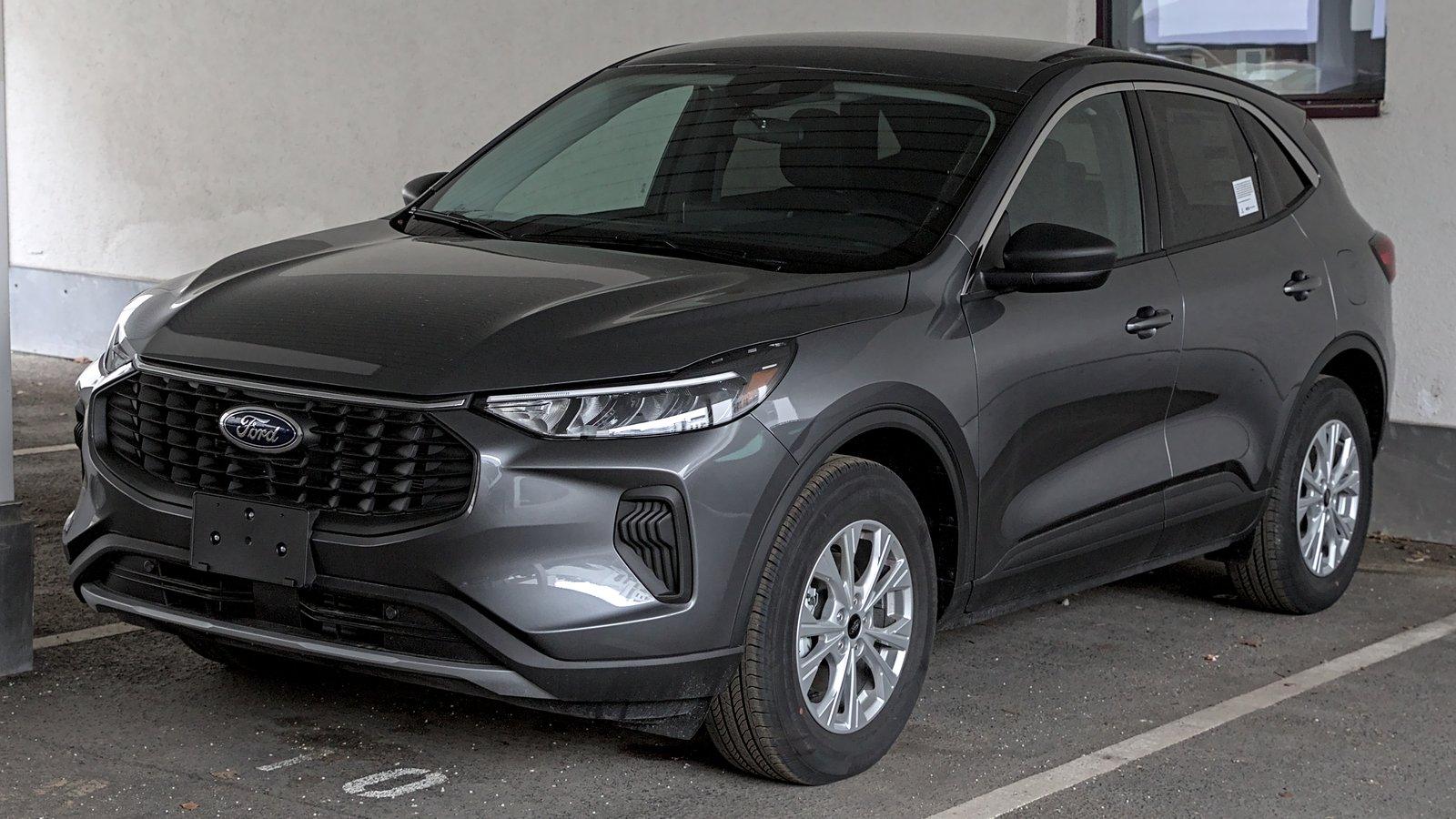

Escape complaints, recalls and recent filings by year
Each row below is one model year, counted from what NHTSA's public API returned when we queried it on Oct. 12, 2026. It gives complaints, recall campaigns, crash or fire reports, and complaints filed in the two years since Oct. 12, 2024.
The last column separates live problems from old ones. The 2017 has 1,063 of its 2,691 complaints in that window, 39.5 percent, and the 2018 has 876 of 1,806, or 48.5 percent. The five 2008-2012 model years, with 8,159 complaints between them, drew 239 in the same two years.
The crash and fire flags single out different years from the totals. The 2014 has 104 complaints reporting a fire, the most of any year, the 2013 has 90, and no other year has more than 20. The 2008 has the most complaints reporting a crash, 72. Few complaints report a death: three for the 2014, two each for the 2005, 2006 and 2007, and one for the 2024.
Crash-test results are a separate question from complaints. NHTSA's ratings API gives the 2011 and 2012 Escape three stars overall, the 2013-2016 four and the 2017-2024 five, and returns no overall rating for 2005-2010.
2013 and 2014: 1.6-liter fire recalls and shifter recalls
Both years' complaints list the engine more than any other component: 1,268 of the 2013's 2,754 and 726 of the 2014's 2,088. Descriptions mention coolant in 705 of the 2013 complaints and 540 of the 2014's.
Recall 12V-336 covers 2013 Escapes with a 1.6-liter engine built from Oct. 5, 2011, through July 11, 2012, whose engine compartment fuel line may split and leak. Ford told owners to stop driving and have a dealer pick the car up. Of the 79 campaigns the Escape query returns for 2005-2024, it is the only one NHTSA flags Park It (do not drive).
Under 12V-431, the cylinder head cup plug may come loose and dump engine coolant, and as the coolant evaporates on the hot engine, the glycol may ignite. Under 12V-551, coolant system leaks may make the engine overheat and leak flammable fluids, which could start a fire if they reach the hot exhaust.
Of these four 1.6-liter campaigns, 12V-336, 12V-431, 12V-551 and 13V-583, the last is the largest, with 139,917 vehicles potentially affected. 13V-583 covers 2013 Escapes with the 1.6-liter engine built from Oct. 5, 2011, through June 2, 2013, whose cylinder head may overheat in spots and crack, letting oil leak. Dealers modify the engine shielding, cooling and control systems, and NHTSA's record says every covered car needs this repair even if it was already fixed under 12V-551. A fifth 1.6-liter campaign that warns of a fire, 13V-584, covers cars whose fuel line may have been installed incorrectly in the 12V-336 repair.
For the 2014, the matching campaign is 17V-209, which also covers some Fiesta ST, Fusion and Transit Connect models with the 1.6-liter engine. Driven with too little coolant, that engine's cylinder head may overheat, crack and leak oil onto hot parts; the fix is a coolant level sensor.
The 2014 also has 481 complaints listing the power train, which we did not sort further. Two recalls cover a shifter cable bushing that may wear and detach, so the lever can be moved to Park while the transmission may not be in Park. They are 18V-471 for 2013-2014 Escapes with six-speed automatics, and 22V-413 for 2013-2019 Escapes.
2017 and 2018: coolant complaints and Ford's programs, no safety recall
The 2017 has 2,691 complaints, second only to the 2013, and 1,987 of them list the engine or engine cooling. The 2018 repeats the pattern on a smaller scale: 1,436 of its 1,806 complaints do the same. Of the 1,939 complaints about the two years filed since Oct. 12, 2024, 1,673 list the engine or engine cooling.
Coolant is the word that stands out: it appears in 1,512 complaint descriptions for the 2017 and 1,136 for the 2018. Both are more than the 2013's 705, the year of the coolant-leak recalls. In 911 of the 2017 complaints, the description mentions coolant together with a cylinder, a head gasket or the engine block. The reports keep coming: since Oct. 12, 2024, 772 complaints about the 2017 and 630 about the 2018 have mentioned coolant. The 2019 has far fewer complaints, 594, but 280 mention coolant and 317 were filed in the past two years.
Using the engine spellings listed in our method, the 2017 coolant complaints name the 2.0-liter more often than the 1.5-liter, 134 times to 117. In the 2018 coolant complaints the 1.5-liter leads, 117 to 37. A match only means the word is in an owner's report; we did not verify these reports and do not quote them.
No safety recall covers these complaints: none of the 2017, 2018 or 2019 recall campaigns has a component in NHTSA's ENGINE categories. The closest is 26V-011, filed under electrical equipment in January 2026 for 2013-2019 Escapes with the 2.0-liter engine. Their engine block heater may crack, leak coolant and short circuit when plugged in. That short circuit can raise the risk of a fire, so owners are told to leave the block heater unplugged until the repair is done.
For the 1.5-liter, Ford answered coolant getting into the cylinders with two customer satisfaction programs, which are not safety recalls. Both cover 2017-2019 Escapes built Sept. 17, 2015, through April 8, 2019.
Under 19B37, dealers reprogrammed the engine computer to run the external coolant pump for a time after shutdown. The aim was to reduce the potential for coolant intrusion into the cylinders. That program, first set to end June 30, 2021, was extended to Nov. 30, 2022, with no mileage limit.
Under 21N12, Ford replaces the 1.5-liter short block once at no cost if a dealer confirms coolant in one or more cylinder bores. The cover runs seven years or 84,000 miles from the warranty start date, whichever comes first.
Under the terms in Ford's June 2022 letter, a 2017-2019 Escape whose warranty began before Oct. 12, 2019, or one past 84,000 miles, was outside 21N12 by Oct. 12, 2026. The letter also gave cars already past those limits until Nov. 30, 2022, passed the coverage to later owners and required 19B37 first.
Both programs name only the 1.5-liter, so a 2.0-liter 2017-2019 Escape with coolant trouble has no Ford program in the records we saved.
Between the two peaks, the 2015 and 2016 have 1,110 and 1,146 complaints, of which 353 and 437 were filed since Oct. 12, 2024. Power train is the most listed component for both, in 285 and 320 complaints, which we did not sort further. Coolant appears in 136 and 115 descriptions, and the two years have nine and four recall campaigns. The cooling-system check, the 22V-413 shifter check and, on a 2.0-liter, 26V-011 in the steps below apply to them too.
2020 to 2024: the most recalled Escapes and the newest fire recalls
The fire-risk campaigns that matter most for a used 2020-2022 Escape concern the 1.5-liter engine's fuel injectors, which may crack and leak fuel into the engine compartment. Recall 22V-859, filed in November 2022 for 2020-2023 Escapes and 2021-2023 Bronco Sports with that engine, added software that detects an injector leak, plus a drain tube. It took in every car from an earlier campaign, 22V-191, for an oil separator housing that may crack and leak oil.
Recall 24V-187 extended the injector repair to more 2022 Escapes in March 2024. Recall 25V-165 redid the work on cars repaired incorrectly under either campaign.
In July 2025, recall 25V-467 replaced those three campaigns for 2020-2022 Escapes. Its final remedy is a new high-pressure fuel rail and new injectors, with a software update as the interim repair. Cars fixed under the earlier campaigns need that final remedy too. The record counts 694,271 vehicles potentially affected across the Escape and Bronco Sport.
The record we fetched on Oct. 12, 2026 did not yet show final-remedy letters as sent, although their anticipated date, July 2026, had passed. If the final repair cannot be booked yet, check that the interim software update is on the invoice. Then ask a Ford dealer when the fuel rail and injectors can be replaced, and price the car as carrying an open recall.
The 2020's complaints point somewhere the recalls do not. Structure is its most listed component, in 605 of 1,533 complaints, and 423 of those structure complaints mention a door hinge, door check, check arm or strap, or weld. None of the 2020's 23 recall campaigns lists a door component. Its one body-structure campaign, 25V-829, concerns liftgate hinge covers on 2020-2022 Escapes that may not be secured and can detach. The 2021 shows the same complaint on a smaller scale, in 58 of its 349 complaints.
Recall 21V-625 covers some 2021 Escapes whose fuel delivery module may leak inside the tank and stall the engine.
Recall 25V-685 lists 2020-2022 Escapes without naming an engine. Its block heater may crack, leak coolant and short circuit when plugged in, which can raise the risk of a fire. Until that repair is done, owners are advised to keep it unplugged.
Hybrid and plug-in hybrid Escapes with the 2.5-liter engine have their own fire campaign, 23V-380, which replaced 22V-484. After an engine failure, oil and fuel vapor may collect near hot parts. Owners are told to park and shut the engine off quickly if they hear unexpected engine noises, lose power or see smoke. Dealers replace the engine in 2023 Escapes and update software on the others. If a connecting rod bearing has failed, the engine is replaced too, and 25V-345 redoes the work on cars repaired incorrectly.
Campaign counts fall to 11 for the 2023 and eight for the 2024, but seven and four of them warn of a fire. Three of the 2023's are 22V-859, 23V-380 and 25V-345, described above, which cover 521,746, 125,322 and 1,809 vehicles across all models. The other four list both years; the figure in parentheses counts vehicles across all models in the campaign, not Escapes alone:
- 24V-634 (24 vehicles): fuel injectors may have been assembled without O-ring support discs and can leak fuel.
- 25V-372 (404 vehicles): cylinder heads may have been made improperly, so the ball plugs can fail and leak oil.
- 25V-343 (6,781 vehicles): on certain cars with a 1.5-liter or 2.0-liter MPC engine and a block heater, the heater may overheat while plugged in.
- 24V-954 (20,484 vehicles; NHTSA component: traction battery): a battery cell defect may cause an internal short circuit; owners are told not to charge the battery until it is fixed.
2005-2012: steering assist, speed control and fuel-leak recalls
Steering leads the complaints for the 2008, 2009 and 2011: 1,237 of the 2008's 2,417, 828 of the 2009's 1,693 and 410 of the 2011's 1,317. Recall 14V-284 covers 2008-2011 Escapes and Mercury Mariners built from Aug. 18, 2006, through Sept. 11, 2010. On those cars the steering torque sensor may fail to read the driver's input, so the electric power steering assist can drop out. Dealers update the steering and instrument cluster software, and replace parts on cars that show a history of the fault.
The 2010 is the exception: vehicle speed control leads, in 566 complaints, ahead of power train, 513, and the engine, 505, while steering has 441. None of the 2010's five recall campaigns covers speed control. Escapes from 2010 to 2012 with the 3.0-liter engine share recall 16V-777: the fuel delivery module may crack and leak fuel, a fire risk near an ignition source.
The 2005 has 1,584 complaints, led by suspension, 489, and structure, 459. Hybrid Escapes from 2005 to 2008 have recall 14V-526: the hybrid system's coolant pump may fail and let the electronics overheat. That can shut down the powertrain in a stall-like condition.
Twenty model years in four groups
Grouping the years shows where the reports pile up. The groups are ours, and the 2013-2019 one alone holds 48.1 percent of all complaints about 2005-2024 Escapes and 73.3 percent of those filed since Oct. 12, 2024. Complaint counts below come from the Escape query alone; the separate hybrid and plug-in counts follow the list.
- 2005-2007: 2,697 complaints, 116 reporting a crash or fire, 11 filed since Oct. 12, 2024, and seven recall campaigns; the 2007 has the fewest complaints, 393.
- 2008-2012: 8,159 complaints, plus 205 from the hybrid queries; 234 reporting a crash or fire, 239 recent, and seven campaigns; the 2012 has the fewest complaints, 603.
- 2013-2019: 12,189 complaints, 494 reporting a crash or fire, 3,462 recent, and 33 campaigns; the 2019 has the fewest complaints, 594.
- 2020-2024: 2,292 complaints, plus 511 from the hybrid and plug-in queries; 63 reporting a crash or fire, 1,012 recent, and 36 campaigns; the 2024 has the fewest complaints, 76.
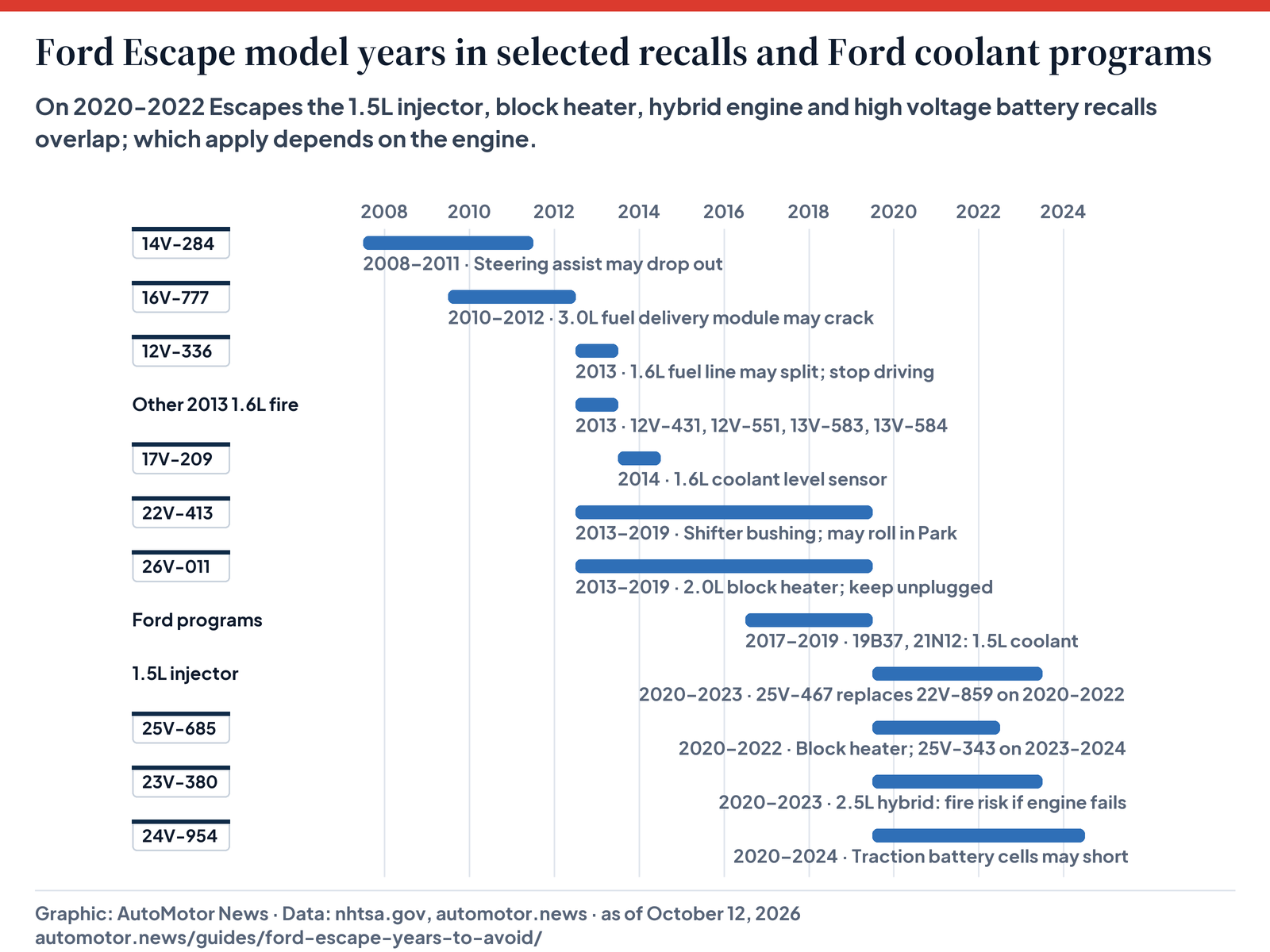
Ford Escape model years in selected recalls and Ford coolant programs
On 2020-2022 Escapes the 1.5L injector, block heater, hybrid engine and high voltage battery recalls overlap; which apply depends on the engine.
Show the data
| Label | What | From | To | Units | Source |
|---|---|---|---|---|---|
| 14V-284 | Steering assist may drop out | 2008 | 2011 | 16 | |
| 16V-777 | 3.0L fuel delivery module may crack | 2010 | 2012 | 18 | |
| 12V-336 | 1.6L fuel line may split; stop driving | 2013 | 2013 | 9, 30 | |
| Other 2013 1.6L fire | 12V-431, 12V-551, 13V-583, 13V-584 | 2013 | 2013 | 30, 10, 11, 31, 12 | |
| 17V-209 | 1.6L coolant level sensor | 2014 | 2014 | 13 | |
| 22V-413 | Shifter bushing; may roll in Park | 2013 | 2019 | 15 | |
| 26V-011 | 2.0L block heater; keep unplugged | 2013 | 2019 | 27 | |
| Ford programs | 19B37, 21N12: 1.5L coolant | 2017 | 2019 | 34, 32 | |
| 1.5L injector | 25V-467 replaces 22V-859 on 2020-2022 | 2020 | 2023 | 20, 23 | |
| 25V-685 | Block heater; 25V-343 on 2023-2024 | 2020 | 2022 | 31, 3 | |
| 23V-380 | 2.5L hybrid: fire risk if engine fails | 2020 | 2023 | 25 | |
| 24V-954 | Traction battery cells may short | 2020 | 2024 | 3, 31 |
Hybrid and plug-in Escapes: complaints and recalls outside the table
NHTSA files some hybrid and plug-in hybrid complaints under separate model names that the Escape query does not return, so they are not in the table. They add 153 complaints for the 2009, 37 for the 2011 and 15 for the 2012. For 2020 to 2024 they add 289 (288 from the HEV query, one from the PHEV), 30, 147, 34 and 11, so 716 across the eight years.
With them counted, the 2022 edges past the 2021, 381 complaints to 379, the reverse of the table's order. The 2020 rises to 1,822, the 2023 to 134 and the 2024 to 87.
Recall counts need the same care: the hybrid and plug-in recall queries return five campaigns the Escape query does not, 06V-382, 22V-109, 25V-789, 25V-881 and 26V-091.
Two concern the plug-in hybrid's high-voltage battery: 25V-789 lists 2020-2024 Escape plug-ins and 26V-091 lists 2022-2026 ones. In both, a defect in one or more battery cells may cause an internal short circuit and battery failure, which can also raise the risk of a fire.
Of the other three, 06V-382 covers a hybrid intermediate shaft that may fracture. 22V-109 covers a 2021 Escape Hybrid crankshaft that may have been made incorrectly. 25V-881 covers 2020 Escape Hybrid software that may shift the car into neutral.
Steps before you buy a used Escape
- Our free check names the recalls covering an Escape's make, model and year; to learn whether one is still unrepaired on the car itself, enter its 17-character VIN on NHTSA.gov. Under 49 CFR 573.15, larger makers must also offer a free VIN search that shows recalls not completed on that car. At a minimum it must include recalls whose owner notification campaign started in the past 15 calendar years, so older campaigns on an older Escape may not show.
- Confirm which engine the car has before the engine-specific steps below. Under 49 CFR 565.15, VIN characters 4 through 8 must encode the engine type, decipherable with information Ford supplies, so ask a Ford dealer to confirm it from the VIN.
- 2008-2012: on a 2008-2011, confirm steering recall 14V-284 is done; on a 2010-2012 with the 3.0-liter engine, confirm fuel delivery module recall 16V-777.
- 2013-2014: on a 2013 with the 1.6-liter engine, look for records of 12V-336 and 13V-584, and of 12V-431, 12V-551 and 13V-583. A car fixed under 12V-551 still needs 13V-583. On a 2014 with the 1.6-liter, confirm the coolant level sensor from 17V-209 is fitted, and on a 2013-2014 with the 2.0-liter, confirm 14V-495.
- 2013-2019: check that the car holds in Park on a slope, and confirm shifter-cable recall 22V-413. Our advice, not the record's: use the parking brake until it is done. On a 2013-2014 with the six-speed automatic, use the parking brake until 18V-471 is done, as its record directs. On a 2015 with the 2.0-liter, also confirm 22V-254: the bushing that attaches the shifter cable to the transmission may degrade or detach.
- 2015-2019: on any engine, check the coolant level with the engine cold and look for leaks under the car and around the engine. Ask whether coolant has been topped up or the engine replaced, and pay a mechanic for a cooling-system pressure test.
- 2017-2019 with the 1.5-liter: have a Ford dealer check the VIN against open recalls and Ford's customer satisfaction programs, including 19B37 and 21N12. Ask too for records of any engine or head-gasket work done under them, since no safety recall covers the coolant complaints. For 21N12, ask the dealer for the warranty start date and the mileage, and whether the 21N12 terms have changed since Ford's June 2022 letter. That letter says coolant in the cylinders can lead to coolant loss, excessive tailpipe smoke or a lit malfunction indicator light from engine misfire.
- Block heaters, 2013-2024: on a 2013-2019 with the 2.0-liter engine, do not plug the heater in until 26V-011 is done, and on a 2020-2022, not until 25V-685 is done. Either repair may not be bookable yet: both records say more letters will follow once the final remedy is available, which 25V-685 anticipated in September 2026. On certain 2023-2024 Escapes with a 1.5-liter or 2.0-liter MPC engine and a block heater, 25V-343 warns the heater may overheat while plugged in. Our advice, not the record's: leave it unplugged until that repair is done too.
- 2020-2022 with the 1.5-liter: get the dealer's invoice for recall 25V-467. Check that it shows the new fuel rail and injectors. If it shows only the interim software update, ask a Ford dealer when the final repair can be done and treat it as open.
- 2020-2023 hybrid or plug-in hybrid: confirm that the 23V-380 work, or the 25V-345 redo, is on record.
- 2020-2024: confirm in NHTSA's VIN lookup or with a Ford dealer that high voltage battery recall 24V-954 (NHTSA component: traction battery) is done or not listed. Until it is, owners are advised not to charge the battery. On a plug-in hybrid, also confirm 25V-789 and, from the 2022, 26V-091. Until 25V-789 and 26V-091 are done, owners are advised to use only Auto EV mode and will be instructed by mail to limit the battery's maximum charge.
- 2020-2021: open and close the front doors several times and look and listen at the hinges and door checks; no recall lists a door component.
- Where NHTSA's VIN lookup or a Ford dealer shows an open recall, ask the dealer when the free repair can be done. Agree with the seller who arranges it before you pay. For everything else, follow our recall-check walkthrough and the used-car inspection checklist.
Frequently asked questions
Which Ford Escape engine should I avoid?
The 1.6-liter carries the 2013-2014 engine fire recalls, and the 1.5-liter carries the 2020-2022 injector fire recalls and Ford's 2017-2019 coolant programs.
- 1.6-liter: fire campaigns 12V-336, 12V-431, 12V-551, 13V-583 and 13V-584 on the 2013, and 17V-209 on the 2014.
- 1.5-liter: injector campaigns 22V-859, 24V-187, 25V-165 and 25V-467 on the 2020-2022, and Ford programs 19B37 and 21N12 on the 2017-2019.
- 2.0-liter: of the campaigns that warn of a fire, only the block-heater ones, 26V-011 and 25V-343, name it.
- 2.0-liter: 14V-495 covers 2013-2014 Escapes whose engine wiring to the manifold pressure sensor may send wrong signals and stall the engine; 22V-254 covers certain 2015 Escapes whose shifter cable bushing may degrade or detach.
- 2.0-liter: neither Ford coolant program names it, though 2017 coolant complaints name it more often than the 1.5-liter (counts above).
- 2.5-liter (hybrid and plug-in hybrid): engine-failure fire campaign 23V-380, which replaced 22V-484, and 25V-345, which redoes that work on cars repaired incorrectly.
Is the 2020 Ford Escape a good used buy?
Only with its recall record in hand: no year has more campaigns, and 533 of its 1,533 complaints arrived since Oct. 12, 2024. Ask for proof of the 25V-467 injector repair and, on a hybrid, the 23V-380 work, two of its 10 campaigns that warn of a fire. Then inspect the doors, because no recall covers the structure complaints that mention a door hinge, door check, check arm or strap, or weld.
What is the best Ford Escape year to buy used?
For a newer Escape, look first at the 2023-2024; among older ones, the 2012; and within 2013-2019, the 2019. No year is free of complaints or recalls: every year has at least two campaigns.
- 2023-2024: the fewest complaints of any Escape year (100 and 76), the fewest filed since Oct. 12, 2024 of any 2013-2024 year (70 and 74), and five-star ratings.
- They also have 11 and eight campaigns, seven and four warning of a fire, though two of those cover only 24 and 404 vehicles across all models; get the recall record.
- 2012: 603 complaints, the fewest of the 2008-2012 years; two campaigns, the fewest of any year; and a three-star rating.
- 2019: 594 complaints, the fewest of the 2013-2019 years, but 280 mention coolant and 317 were filed since Oct. 12, 2024.
Last updated .
This story was prepared with AI assistance and fact-checked by our AI review process against its sources, then reviewed by Paul Grice before publication. Our AI policy.
Sources
All accessed 2026-10-12.
- NHTSA complaints file: field descriptions (CMPL.txt) (primary source).
- NHTSA complaints API, complaintsByVehicle: 2017 Ford Escape (one of the 20 model-year queries behind our data; every URL is in the CSV) (primary source).
- NHTSA recalls API, recallsByVehicle: 2020 Ford Escape (one of the 20 model-year queries behind our data; every URL is in the CSV) (primary source).
- NHTSA 5-Star Safety Ratings API: 2017 Ford Escape SUV FWD (one of the rating queries behind the CSV's NCAP column) (primary source).
- NHTSA complaints API, complaintsByVehicle: 2020 Ford Escape HEV (primary source).
- NHTSA complaints API, complaintsByVehicle: 2008 Ford Escape Hybrid (primary source).
- 49 CFR 565.13: VIN general requirements (eCFR) (primary source).
- 49 CFR 573.15: Public availability of motor vehicle recall information (eCFR) (primary source).
- NHTSA recall 12V-336 (fuel line split, 2013 Escape 1.6L), campaign record (primary source).
- NHTSA recall 12V-431 (cylinder head cup plug, 2013 Escape 1.6L), campaign record (primary source).
- NHTSA recall 12V-551 (coolant leaks and overheating, 2013 Escape 1.6L), campaign record (primary source).
- NHTSA recall 13V-583 (cylinder head overheating and oil leak, 2013 Escape 1.6L), campaign record (primary source).
- NHTSA recall 17V-209 (coolant level sensor, 2014 Escape 1.6L GTDI), campaign record (primary source).
- NHTSA recall 18V-471 (shifter cable bushing, 2013-2014 Escape), campaign record (primary source).
- NHTSA recall 22V-413 (shifter cable bushing, 2013-2019 Escape), campaign record (primary source).
- NHTSA recall 14V-284 (electric power steering torque sensor, 2008-2011 Escape), campaign record (primary source).
- NHTSA recall 14V-526 (hybrid coolant pump, 2005-2008 Escape Hybrid), campaign record (primary source).
- NHTSA recall 16V-777 (fuel delivery module, 2010-2012 Escape 3.0L), campaign record (primary source).
- NHTSA recall 22V-191 (oil separator housing, 2020-2022 Escape 1.5L), campaign record (primary source).
- NHTSA recall 22V-859 (fuel injector crack, 2020-2023 Escape 1.5L), campaign record (primary source).
- NHTSA recall 24V-187 (fuel injector crack, 2022 Escape 1.5L), campaign record (primary source).
- NHTSA recall 25V-165 (fuel injector re-repair, 2020-2022 Escape), campaign record (primary source).
- NHTSA recall 25V-467 (fuel rail and injectors, 2020-2022 Escape 1.5L), campaign record (primary source).
- NHTSA recall 22V-484 (engine failure fire risk, 2020-2022 Escape 2.5L HEV/PHEV), campaign record (primary source).
- NHTSA recall 23V-380 (engine failure fire risk, 2020-2023 Escape 2.5L HEV/PHEV), campaign record (primary source).
- NHTSA recall 25V-345 (re-repair of 23V-380, 2020-2023 Escape 2.5L HEV/PHEV), campaign record (primary source).
- NHTSA recall 26V-011 (engine block heater, 2013-2019 Escape), campaign record (primary source).
- NHTSA recall 25V-829 (liftgate hinge, 2020-2022 Escape), campaign record (primary source).
- AutoMotor News data: NHTSA complaints, recalls and crash ratings per Ford Escape model year, 2005-2024 (ford-escape-nhtsa-by-year.csv) (our analysis of source 1, source 2, source 3 and source 4).
- AutoMotor News data: Ford Escape complaint measures, rankings, group totals, hybrid overlap and method notes (ford-escape-findings.csv) (our analysis of source 1, source 2, source 3, source 4, source 5, source 6, source 36, source 37, source 38, source 39 and source 40).
- AutoMotor News data: the 79 recall campaigns NHTSA lists for 2005-2024 Ford Escapes (ford-escape-recalls.csv) (our analysis of source 3).
- Ford dealer letter: Customer Satisfaction Program 19B37, Supplement #2 (Feb. 27, 2020), 2017-2019 Escape and Fusion 1.5L GTDI, PCM reprogramming (NHTSA manufacturer communication MC-10171957) (primary source).
- Ford dealer letter: Customer Satisfaction Program 19B37, Supplement #1, 2017-2019 Escape and Fusion 1.5L GTDI, PCM reprogramming (NHTSA manufacturer communication MC-10171011) (primary source).
- Ford dealer letter: Customer Satisfaction Program 21N12 (June 9, 2022), 2017-2019 Escape and Fusion 1.5L GTDI, short block replacement after coolant intrusion (NHTSA manufacturer communication MC-10213732) (primary source).
- 49 CFR 565.15: VIN content requirements (eCFR) (primary source).
- NHTSA recalls API, recallsByVehicle: 2020 Ford Escape PHEV (primary source).
- NHTSA recalls API, recallsByVehicle: 2022 Ford Escape PHEV (primary source).
- NHTSA recalls API, recallsByVehicle: 2021 Ford Escape Hybrid (primary source).
- NHTSA recalls API, recallsByVehicle: 2020 Ford Escape Hybrid (primary source).
- NHTSA recalls API, recallsByVehicle: 2006 Ford Escape HEV (primary source).
- AutoMotor News: free VIN and recall check, page text (what the check lists: recalls for a make, model and year) (our analysis of source 3).