
Guide
Honda CR-V years to avoid: 2017 to 2019 lead NHTSA complaints
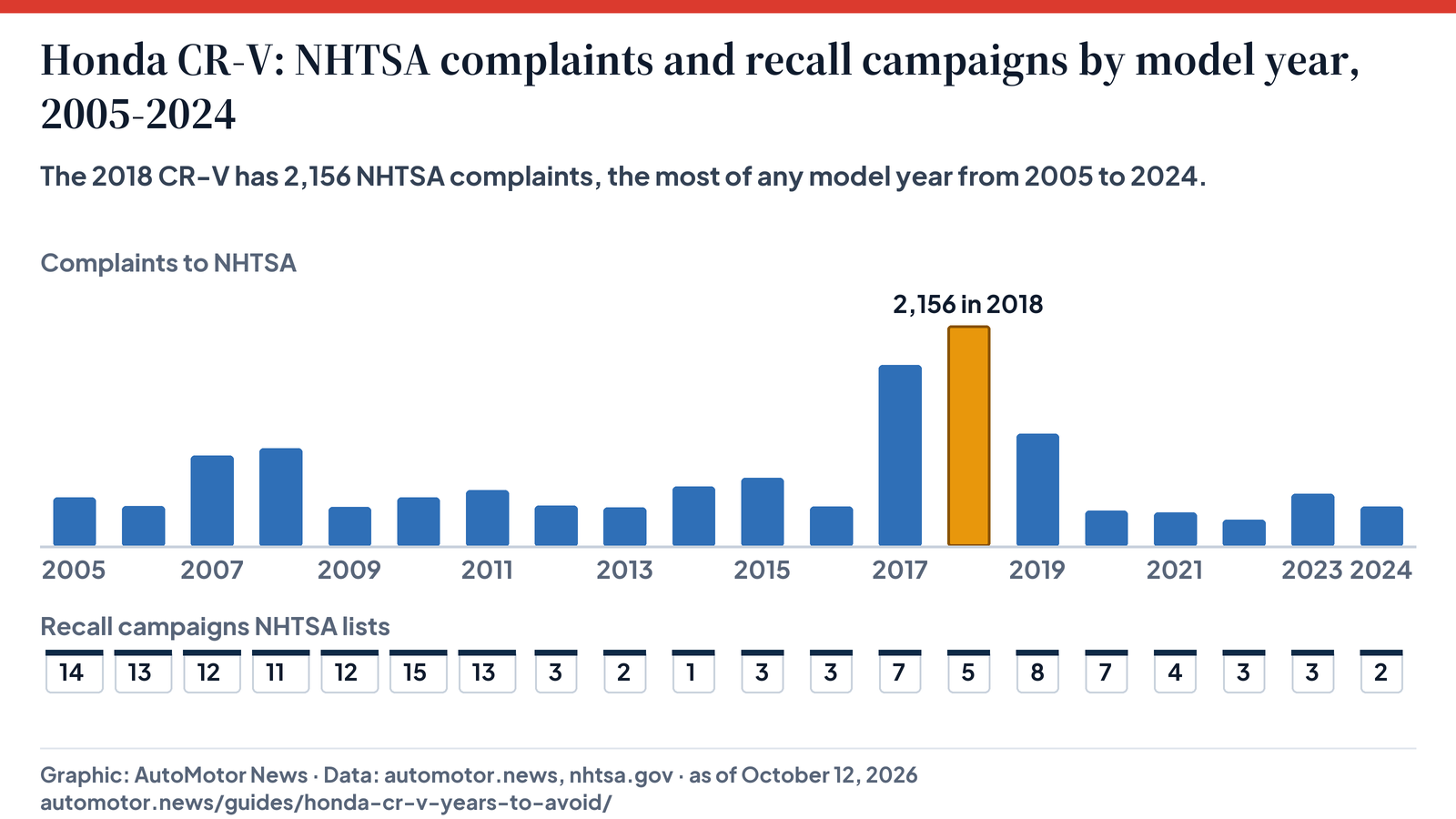
The 2018 CR-V has 2,156 complaints on file with NHTSA, 564 of them filed since Oct. 12, 2024, and those recent reports list the steering more than any other component.
Checked against 36 sources (36 primary)

Last updated · Updated · 15 min read
Highest year in amber. Every year, with sources · Download this chart (PNG)
Quick answer
Check the 2017, 2018 and 2019 CR-V hardest: their 1,773, 2,156 and 1,103 NHTSA complaints lead every model year from 2005 to 2024.
On the 2017 and 2018, over 200 complaints each mention fuel in the oil, oil dilution or a rising oil level.
The five years with the fewest complaints are the 2022, 2021, 2020, 2013 and 2009, though the 2009 has 12 recall campaigns to the 2013's two. These are owner reports that NHTSA has not verified, not adjusted for sales or age.
At a glance
-
Most complaints
2,156Model year: 2018
complaints to NHTSA [30]
-
Fewest complaints
263Model year: 2022
complaints to NHTSA [30]
-
Most recall campaigns
15Model year: 2010
recall campaigns [30]
| Model year | Complaints to NHTSA | Recall campaigns | Crash or fire reported | New reports since Oct. 12, 2024 |
|---|---|---|---|---|
| 2024 | 391 | 2 | 28 | 247 |
| 2023 | 515 | 3 | 22 | 143 |
| 2022 | 263 | 3 | 6 | 160 |
| 2021 | 334 | 4 | 15 | 201 |
| 2020 | 354 | 7 | 23 | 148 |
| 2019 | 1,103 | 8 | 32 | 314 |
| 2018 | 2,156 (highest) | 5 | 48 | 564 (highest) |
| 2017 | 1,773 | 7 | 46 | 265 |
| 2016 | 393 | 3 | 43 | 48 |
| 2015 | 672 | 3 | 41 | 43 |
| 2014 | 587 | 1 | 42 | 25 |
| 2013 | 382 | 2 | 22 | 23 |
| 2012 | 403 | 3 | 31 | 35 |
| 2011 | 554 | 13 | 31 | 26 |
| 2010 | 481 | 15 (highest) | 32 | 14 |
| 2009 | 386 | 12 | 30 | 5 |
| 2008 | 962 | 11 | 47 | 13 |
| 2007 | 887 | 12 | 38 | 10 |
| 2006 | 398 | 13 | 42 | 4 |
| 2005 | 479 | 14 | 57 (highest) | 7 |
The highest value in each column is marked in amber. Raw counts, not adjusted for sales.
All 80 figures, with sources
| 2005 Honda CR-V: complaints to NHTSA | 479 |
|---|---|
| 2005 Honda CR-V: recall campaigns | 14 |
| 2005 Honda CR-V: crash or fire reported | 57 |
| 2005 Honda CR-V: new reports since Oct. 12, 2024 | 7 |
| 2006 Honda CR-V: complaints to NHTSA | 398 |
| 2006 Honda CR-V: recall campaigns | 13 |
| 2006 Honda CR-V: crash or fire reported | 42 |
| 2006 Honda CR-V: new reports since Oct. 12, 2024 | 4 |
| 2007 Honda CR-V: complaints to NHTSA | 887 |
| 2007 Honda CR-V: recall campaigns | 12 |
| 2007 Honda CR-V: crash or fire reported | 38 |
| 2007 Honda CR-V: new reports since Oct. 12, 2024 | 10 |
| 2008 Honda CR-V: complaints to NHTSA | 962 |
| 2008 Honda CR-V: recall campaigns | 11 |
| 2008 Honda CR-V: crash or fire reported | 47 |
| 2008 Honda CR-V: new reports since Oct. 12, 2024 | 13 |
| 2009 Honda CR-V: complaints to NHTSA | 386 |
| 2009 Honda CR-V: recall campaigns | 12 |
| 2009 Honda CR-V: crash or fire reported | 30 |
| 2009 Honda CR-V: new reports since Oct. 12, 2024 | 5 |
| 2010 Honda CR-V: complaints to NHTSA | 481 |
| 2010 Honda CR-V: recall campaigns | 15 |
| 2010 Honda CR-V: crash or fire reported | 32 |
| 2010 Honda CR-V: new reports since Oct. 12, 2024 | 14 |
| 2011 Honda CR-V: complaints to NHTSA | 554 |
| 2011 Honda CR-V: recall campaigns | 13 |
| 2011 Honda CR-V: crash or fire reported | 31 |
| 2011 Honda CR-V: new reports since Oct. 12, 2024 | 26 |
| 2012 Honda CR-V: complaints to NHTSA | 403 |
| 2012 Honda CR-V: recall campaigns | 3 |
| 2012 Honda CR-V: crash or fire reported | 31 |
| 2012 Honda CR-V: new reports since Oct. 12, 2024 | 35 |
| 2013 Honda CR-V: complaints to NHTSA | 382 |
| 2013 Honda CR-V: recall campaigns | 2 |
| 2013 Honda CR-V: crash or fire reported | 22 |
| 2013 Honda CR-V: new reports since Oct. 12, 2024 | 23 |
| 2014 Honda CR-V: complaints to NHTSA | 587 |
| 2014 Honda CR-V: recall campaigns | 1 |
| 2014 Honda CR-V: crash or fire reported | 42 |
| 2014 Honda CR-V: new reports since Oct. 12, 2024 | 25 |
| 2015 Honda CR-V: complaints to NHTSA | 672 |
| 2015 Honda CR-V: recall campaigns | 3 |
| 2015 Honda CR-V: crash or fire reported | 41 |
| 2015 Honda CR-V: new reports since Oct. 12, 2024 | 43 |
| 2016 Honda CR-V: complaints to NHTSA | 393 |
| 2016 Honda CR-V: recall campaigns | 3 |
| 2016 Honda CR-V: crash or fire reported | 43 |
| 2016 Honda CR-V: new reports since Oct. 12, 2024 | 48 |
| 2017 Honda CR-V: complaints to NHTSA | 1,773 |
| 2017 Honda CR-V: recall campaigns | 7 |
| 2017 Honda CR-V: crash or fire reported | 46 |
| 2017 Honda CR-V: new reports since Oct. 12, 2024 | 265 |
| 2018 Honda CR-V: complaints to NHTSA | 2,156 |
| 2018 Honda CR-V: recall campaigns | 5 |
| 2018 Honda CR-V: crash or fire reported | 48 |
| 2018 Honda CR-V: new reports since Oct. 12, 2024 | 564 |
| 2019 Honda CR-V: complaints to NHTSA | 1,103 |
| 2019 Honda CR-V: recall campaigns | 8 |
| 2019 Honda CR-V: crash or fire reported | 32 |
| 2019 Honda CR-V: new reports since Oct. 12, 2024 | 314 |
| 2020 Honda CR-V: complaints to NHTSA | 354 |
| 2020 Honda CR-V: recall campaigns | 7 |
| 2020 Honda CR-V: crash or fire reported | 23 |
| 2020 Honda CR-V: new reports since Oct. 12, 2024 | 148 |
| 2021 Honda CR-V: complaints to NHTSA | 334 |
| 2021 Honda CR-V: recall campaigns | 4 |
| 2021 Honda CR-V: crash or fire reported | 15 |
| 2021 Honda CR-V: new reports since Oct. 12, 2024 | 201 |
| 2022 Honda CR-V: complaints to NHTSA | 263 |
| 2022 Honda CR-V: recall campaigns | 3 |
| 2022 Honda CR-V: crash or fire reported | 6 |
| 2022 Honda CR-V: new reports since Oct. 12, 2024 | 160 |
| 2023 Honda CR-V: complaints to NHTSA | 515 |
| 2023 Honda CR-V: recall campaigns | 3 |
| 2023 Honda CR-V: crash or fire reported | 22 |
| 2023 Honda CR-V: new reports since Oct. 12, 2024 | 143 |
| 2024 Honda CR-V: complaints to NHTSA | 391 |
| 2024 Honda CR-V: recall campaigns | 2 |
| 2024 Honda CR-V: crash or fire reported | 28 |
| 2024 Honda CR-V: new reports since Oct. 12, 2024 | 247 |
Source for every row: source 30.

CR-V complaints and recalls, 2005 to 2024
The table gives four counts for each model year, from the records NHTSA's public API returned on Oct. 12, 2026. They are complaints, recall campaigns, complaints flagged for a crash or a fire, and complaints filed since Oct. 12, 2024. It covers the 2005 to 2024 model years, the 20 we pulled from NHTSA, so it has no counts for 2002-2004 CR-Vs or for 2025 and later models.
The last column shows which years are still drawing reports: the 2018 leads with 564, then the 2019 (314), 2017 (265), 2024 (247) and 2021 (201). What owners report on the 2018 has shifted: in complaints filed since Oct. 12, 2024, the steering is listed 183 times and the engine 85.
Recall counts need a second look, because a campaign counts in every year it reaches and some are tiny. Of the 2017's seven campaigns, 23V-524 covers five vehicles with a wrong certification label, and 17V-256 covers 1,425 vehicles whose label ink may wipe off with an alcohol solvent.
Complaints reporting an injury peak on the 2018 (39), the 2008 (37) and the 2019 (31). Five complaints in the 20 years report a death, as owner reports NHTSA has not verified: one each on the 2007, 2010 and 2019, and two on the 2014.
What owners of 2017 and 2018 CR-Vs reported
The engine is the component listed most on both years: in 531 complaints on the 2017 and 530 on the 2018. In 215 complaints on the 2017 and 218 on the 2018, the owner's description mentions fuel or gas in the oil, oil dilution or a rising oil level. The count falls to 35 on the 2019 and to six or fewer on every later year.
Those reports are mostly old: two of the 2017's 215 and six of the 2018's 218 were filed since Oct. 12, 2024.
Honda's own dealer notices, filed with NHTSA, tie the problem to the 1.5-liter turbo engine. On Oct. 22, 2018, Honda announced a product update for certain 2017-18 CR-Vs with that engine sold in Maine, Minnesota, North Dakota, South Dakota and Wisconsin. By Dec. 21, 2018, the update covered such CR-Vs sold in 21 cold-weather states.
Honda told dealers that in some extreme cold-weather states, CR-Vs driven on very short trips may get engine oil dilution, which can raise the oil level and cause a misfire.
On April 5, 2019, Honda announced a warranty extension for certain 2016-18 Civics and 2017-18 CR-Vs, citing drivability concerns. It moved the powertrain warranty on the camshafts and rocker arm assemblies from 5 years or 60,000 miles to 6 years with unlimited miles, counted from the original date of sale. Honda said most vehicles would need only a software update.
This was never a safety recall: none of the recall campaigns NHTSA lists for 2017-2022 CR-Vs mentions oil in its summary. Honda's CR-V timeline says the 1.5-liter turbo powered EX and higher trims from 2017 and became standard on the LX for 2020. The other engine it lists for 2017-2019 is a 2.4-liter four-cylinder.
Automatic braking complaints on 2017 to 2022 models
For phantom braking, the closest measure in NHTSA's data is its forward collision avoidance component, which appears in 281 complaints on the 2017, 394 on the 2018 and 298 on the 2019. They drop to 73 on the 2020, 87 on the 2021 and 44 on the 2022, for 1,177 across the six years.
NHTSA opened a preliminary evaluation, PE22-003, on Feb. 21, 2022, into inadvertent automatic emergency braking on 2017-2019 CR-Vs and 2018-2019 Accords. It estimated the population at 1,732,000 vehicles. The complaints it cited describe braking, some with large speed changes, with nothing in the vehicle's path.
NHTSA upgraded the case to an engineering analysis, EA24-002, to assess the scope, frequency and safety consequences of the activations. Its July 18, 2024 letter to Honda covers 2017-2022 CR-Vs and 2018-2022 Accords and cites 1,397 reports across both models of the braking system slowing the car with no collision hazard. That figure is not comparable with the 1,177 CR-V forward collision avoidance complaints counted above. NHTSA's investigations file, downloaded Oct. 12, 2026, shows EA24-002 opened on April 15, 2024 for CR-Vs and lists no closing date. NHTSA also notes that many complaints say Honda dealers could not reproduce the condition.
No recall campaign NHTSA lists for 2017-2022 CR-Vs names forward collision avoidance or service brakes as its component. Honda made its Honda Sensing suite, which includes the collision mitigation braking system, standard on EX and higher trims for 2017 and on all grades for 2020.
Steering complaints on 2018 to 2022 models are still arriving
We also counted complaints that list the steering and whose description mentions steering that sticks, is stuck, stiff or notchy. The 2018 has 199 of them, and 135 were filed since Oct. 12, 2024. The 2022 has 114 (86 recent), the 2019 has 91 (63 recent) and the 2021 has 87 (68 recent).
The only recall NHTSA lists with a steering component for 2017-2022 CR-Vs is 18V-663, a campaign of 54 Civics and CR-Vs. It concerns a torque sensor magnet that can come loose and push steering assist the wrong way during a full-lock turn.
The 2023 is the contrast: 237 complaints with the same steering words, but only 15 filed since Oct. 12, 2024. Certain 2023 and 2024 CR-Vs are covered by recall 24V-744, filed Oct. 3, 2024, for a steering gearbox that may have been manufactured incorrectly and can make the car hard to steer. Dealers replace the worm gear spring and add grease as needed, free of charge.
Recalls that touch the 2017 to 2019 models
Each remedy below is free at a Honda dealer. Unit counts are NHTSA's figure for the whole campaign, across every model it covers, not CR-Vs alone. None of these campaigns asks owners to park outside.
- 17V-442, certain 2017 CR-Vs: a fuel supply pipe that may disconnect and leak while driving, stalling the engine and raising the risk of a fire; dealers replace the pipe. NHTSA counts 32,233 vehicles.
- 23V-158, certain 2017-2020 CR-Vs: front seat belt buckles that may not latch; dealers replace the release buttons or buckles. The campaign covers 448,613 vehicles across several Honda and Acura models.
- 21V-215 (2018-2019) and its expansion 23V-858 (2013-2023 CR-Vs): a fuel pump inside the tank that may fail and stall the engine while driving; dealers replace the pump. 23V-858 alone covers 2,490,460 Honda and Acura vehicles.
- 19V-383, certain 2019 CR-Vs: burrs in the steering wheel's metal core can damage wiring and disable the driver's air bag or set it off without warning. It covers 161,252 vehicles.
- 19V-569 (2019, a fuel tank weld that may leak) and 19V-865 (2019-2020, rear subframe bolts that may loosen) are small: 134 and 358 vehicles.
- 26V-332, filed May 21, 2026, reaches every 2017-2022 CR-V model year: the front passenger seat weight sensor may crack and short circuit, which can make the air bags deploy unintentionally in a crash. Owner letters went out July 7, 2026.
Older CR-Vs: air bags and rusting frames
The 2007 and 2008 drew 887 and 962 complaints, the most of any year before 2017. Air bags lead both (267 and 325 complaints), followed by the electrical system and the door latches and locks. Air bags are the component listed most on every model year from 2007 to 2011. The engine trails far behind on the 2010 and 2011, in 53 and 37 complaints against 217 and 295 for air bags.
Each of the 2005-2011 model years carries 11 to 15 recall campaigns, against one to eight for any year from 2012 on. Seven to 12 of each older year's campaigns concern air bags.
Driver inflators: recall 16V-061 covers 2007-2011 CR-Vs whose driver frontal air bag inflator may take in moisture and, over time, rupture. For the 2005 and 2006, recall 15V-320 covers the driver's inflator. A rupture can send metal fragments into the driver or other occupants, causing serious injury or death.
Passenger inflators: recall 16V-346 covers inflators that may rupture after long exposure to humidity and temperature cycling, on 2007-2011 CR-Vs sold or ever registered in nine states and five U.S. territories. It also covers 2007-2008 CR-Vs in 20 more states and the District of Columbia.
Recall 23V-228 covers 2007-2011 CR-Vs sold or ever registered in 22 states and Washington, D.C., where road salt may corrode the frame and possibly detach the rear trailing arm. The states are Connecticut, Delaware, Illinois, Indiana, Iowa, Kentucky, Maine, Maryland, Massachusetts, Michigan, Minnesota, Missouri, New Hampshire, New Jersey, New York, Ohio, Pennsylvania, Rhode Island, Vermont, Virginia, West Virginia and Wisconsin. Dealers inspect the frame and install a support brace or repair it, and depending on the corrosion, Honda may offer to buy the vehicle back.
The 2005 and 2006 have the most fire-flagged complaints of any year, 18 and 16. Recall 20V-768 covers 2002-2006 CR-Vs whose driver-side power window master switch may take in moisture and fail or melt. An earlier recall on the same switch, 12V-486, says only that it may fail or melt.
On 2007-2010 models, recall 11V-395 updated the automatic transmission software because a broken secondary shaft bearing could stall the engine or let the car roll after it was put in Park.
From the 2012 redesign to the 2023 one
Honda's timeline dates the generations 2007-2011, 2012-2016, 2017-2022 and 2023 on. By those groups, the 2007-2011 CR-Vs drew 3,270 complaints, the 2012-2016 drew 2,437 and the 2017-2022 drew 5,983. The lowest year in each is the 2009 (386), the 2013 (382) and the 2022 (263). NHTSA gives every year from 2012 to 2024 a 5-star overall rating (the 2023 in AWD form only) except the 2015, which has 4 stars.
The 2015 is the high point of the 2012-2016 group with 672 complaints; the engine is listed in 243 and the power train in 150. It was the first CR-V with a continuously variable transmission, Honda says. No recall campaign for the 2015 involves the transmission; its three campaigns are 23V-858, 15V-121 and 17V-305.
The 2014 has one recall campaign and the 2013 two; the 2012 and 2013 share 13V-143, a brake-shift interlock that can let the shifter leave Park without the brake pedal in sub-freezing weather.
The 2023, the first of the current generation, drew 515 complaints, 325 of them listing the steering. NHTSA opened engineering analysis EA23-003 into momentary increased steering effort on 2022-2023 Civics, 2023 Integras and 2023 CR-Vs before Honda filed recall 24V-744. The 2024 has 391 complaints, 247 of them filed since Oct. 12, 2024.
Steps before you buy a used CR-V
- Get the VIN. Our free recall check lists every NHTSA recall for the car's make, model and year, and some may already have been repaired on that car. For open status on that exact car, run the VIN through Honda's own lookup, which federal rules require to show completion status for safety recalls whose owner notification began in the past 15 calendar years. On 2017-2022, look for 26V-332, and on 2017-2020 also for 23V-158; on 2020-2021, for 24V-064; on 2013-2023, for the 23V-858 fuel pump. 24V-064 is for a front passenger seat weight sensor that may crack and short circuit, so the air bag is not suppressed as intended.
- On a 2005-2006, look for air bag inflator recall 15V-320; on a 2007-2011, for inflator recalls 16V-061 and 16V-346.
- On a 2017 or 2018 with the 1.5-liter turbo, pull the dipstick on a cold engine. An oil level above the full mark or a smell of gasoline is a reason to have a mechanic look before you buy.
- Ask for dealer records showing Honda's 2018 oil dilution software update and any related repair. Honda's 2019 warranty extension runs six years from the original date of sale, so on a 2017-18 CR-V first sold before Oct. 12, 2020 it has already ended.
- On a 2017-2022 with Honda Sensing, drive in traffic and on an open road with the system on, and note any braking you did not ask for.
- On a 2018-2024, turn the wheel lock to lock while parked and drive slow curves. Steering that sticks or feels notchy is worth a mechanic's opinion. On a 2023 or 2024, ask for the 24V-744 repair record.
- On a 2007-2011 CR-V that has lived in one of the 22 states listed above or Washington, D.C., have a mechanic inspect the rear frame near the trailing arms. Ask for proof of the 23V-228 inspection too.
- Treat an open recall as part of the deal: get the free repair done before money changes hands, or write it into the sale; our recall-check guide shows each step of a VIN search.
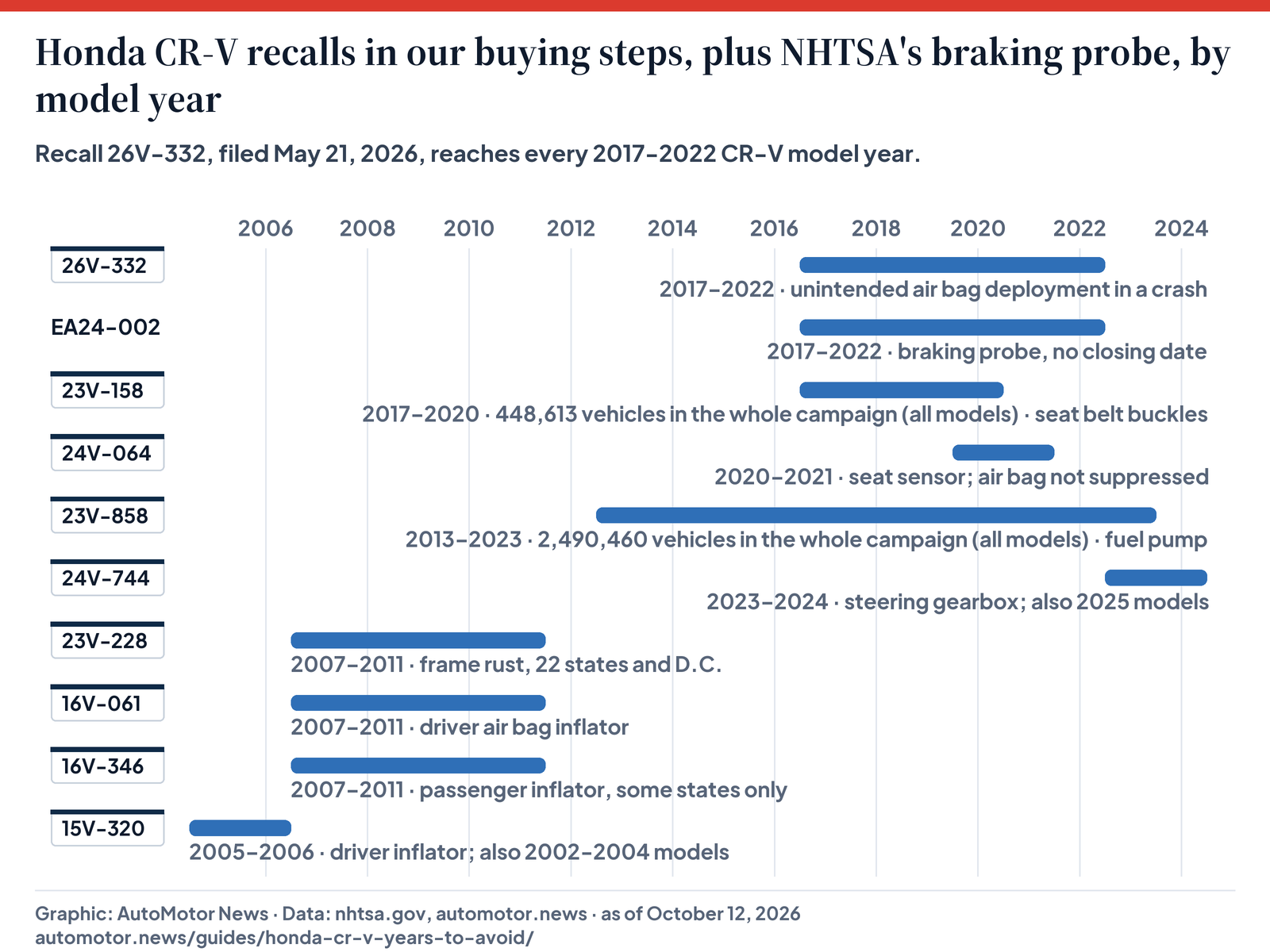
Honda CR-V recalls in our buying steps, plus NHTSA's braking probe, by model year
Recall 26V-332, filed May 21, 2026, reaches every 2017-2022 CR-V model year.
Show the data
| Label | What | From | To | Units | Source |
|---|---|---|---|---|---|
| 26V-332 | unintended air bag deployment in a crash | 2017 | 2022 | 33, 28 | |
| EA24-002 | braking probe, no closing date | 2017 | 2022 | 8, 34 | |
| 23V-158 | seat belt buckles | 2017 | 2020 | 448,613 vehicles in the whole campaign (all models) | 20 |
| 24V-064 | seat sensor; air bag not suppressed | 2020 | 2021 | 33 | |
| 23V-858 | fuel pump | 2013 | 2023 | 2,490,460 vehicles in the whole campaign (all models) | 33, 19 |
| 24V-744 | steering gearbox; also 2025 models | 2023 | 2024 | 33, 21 | |
| 23V-228 | frame rust, 22 states and D.C. | 2007 | 2011 | 22 | |
| 16V-061 | driver air bag inflator | 2007 | 2011 | 23 | |
| 16V-346 | passenger inflator, some states only | 2007 | 2011 | 33, 24 | |
| 15V-320 | driver inflator; also 2002-2004 models | 2005 | 2006 | 33 |
Frequently asked questions
Which CR-V years have oil dilution problems?
The 2017 and 2018: 215 and 218 complaints mention fuel in the oil, oil dilution or a rising oil level, against 35 on the 2019. Honda's 2018 software update and 2019 warranty extension also name 2017-18 CR-Vs. Neither year has a safety recall for it, so whether the fix was done depends on a previous owner having taken the car in.
Is the 2018 Honda CR-V reliable?
NHTSA's records cannot measure reliability, but they show the 2018 with more complaints than any other CR-V year, 2,156, and the most complaints reporting an injury, 39. Steering, not the engine, leads its newest reports; only six filed since Oct. 12, 2024 mention fuel in the oil, oil dilution or a rising oil level. A well-documented 2018 with its recalls and Honda's updates done is a different purchase from one with no records.
What are the best used CR-V years to buy?
By complaint count alone: the 2022 (263), 2021 (334) and 2020 (354), then among older models the 2013 (382) and the 2009 (386), which has 12 recall campaigns to the 2013's two. The 2022 has 114 complaints of sticking, stiff or notchy steering (86 filed since Oct. 12, 2024) and the 2021 has 87 (68 recent), so do the lock-to-lock test in the steps. The 2020-2022 fall inside NHTSA's EA24-002 braking investigation and recall 26V-332, and the 2020-2021 inside 24V-064, so check recall status and test the braking as the steps above describe.
Does the CR-V Hybrid have the same problems?
NHTSA files the hybrid under its own model name, so its complaints are not in the gas CR-V counts on this page. The 2021 CR-V Hybrid has 438 complaints, more than the gas 2021's 334, led by steering (119) and forward collision avoidance (109). Recalls 24V-744 and 26V-332 both name the CR-V Hybrid.
Last updated .
This story was prepared with AI assistance and fact-checked by our AI review process against its sources, then reviewed by Paul Grice before publication. Our AI policy.
Sources
All accessed 2026-10-12.
- NHTSA complaints API: 2018 Honda CR-V (one of 20 per-year queries; every query URL is in the data file) (primary source).
- NHTSA recalls API: 2018 Honda CR-V (one of 20 per-year queries; every query URL is in the data file) (primary source).
- NHTSA SafetyRatings API: 2015 Honda CR-V SUV FWD (one of the per-year rating queries) (primary source).
- NHTSA complaints file: field descriptions (CMPL.txt) (primary source).
- NHTSA complaints API: 2021 Honda CR-V Hybrid (separate model name; every variant query is in our script) (primary source).
- NHTSA Office of Defects Investigation: PE 22-003 opening resume, inadvertent automatic emergency braking (Feb. 21, 2022) (primary source).
- NHTSA Office of Defects Investigation: EA 24-002 opening resume, page 2 (primary source).
- NHTSA Office of Defects Investigation: EA 24-002 information request to American Honda (July 18, 2024) (primary source).
- American Honda dealer notice filed with NHTSA: 2017-18 CR-V engine oil dilution product update (Oct. 22, 2018) (primary source).
- American Honda dealer notice filed with NHTSA: oil dilution product update expanded to 2016-18 Civic, 21 states (Dec. 21, 2018) (primary source).
- American Honda dealer notice filed with NHTSA: 2016-18 Civic and 2017-18 CR-V oil dilution warranty extension (April 5, 2019) (primary source).
- Honda: Honda CR-V Timeline and Milestones (hondanews.com) (primary source).
- NHTSA recall 17V-442: 2017 CR-V fuel supply pipe (campaign record) (primary source).
- NHTSA recall 18V-663: 2017-2018 Civic and CR-V electric power steering (campaign record) (primary source).
- NHTSA recall 19V-569: 2019 CR-V fuel tank weld (campaign record) (primary source).
- NHTSA recall 19V-865: 2019-2020 CR-V rear subframe bolts (campaign record) (primary source).
- NHTSA recall 19V-383: 2019 CR-V driver air bag clockspring (campaign record) (primary source).
- NHTSA recall 21V-215: Honda and Acura low-pressure fuel pump, incl. 2018-2019 CR-V (campaign record) (primary source).
- NHTSA recall 23V-858: Honda and Acura fuel pump, incl. 2013-2023 CR-V (campaign record) (primary source).
- NHTSA recall 23V-158: 2017-2020 CR-V front seat belt buckles (campaign record) (primary source).
- NHTSA recall 24V-744: Honda and Acura steering gearbox, incl. 2023-2024 CR-V (campaign record) (primary source).
- NHTSA recall 23V-228: 2007-2011 CR-V frame corrosion (campaign record) (primary source).
- NHTSA recall 16V-061: 2007-2011 CR-V driver air bag inflator (campaign record) (primary source).
- NHTSA recall 16V-346: Honda and Acura passenger air bag inflator, incl. 2007-2011 CR-V (campaign record) (primary source).
- NHTSA recall 15V-320: Honda driver air bag inflator, incl. 2005-2006 CR-V (campaign record) (primary source).
- NHTSA recall 11V-395: 2007-2010 CR-V automatic transmission (campaign record) (primary source).
- NHTSA recall 13V-143: 2012-2013 CR-V automatic transmission park (campaign record) (primary source).
- NHTSA recall 26V-332: Honda and Acura front passenger seat weight sensor, incl. 2017-2022 CR-V (campaign record) (primary source).
- NHTSA Office of Defects Investigation: EA 23-003 information request to American Honda, steering effort (Sept. 3, 2024) (primary source).
- NHTSA defect investigations file (FLAT_INV): rows for EA24-002, Honda CR-V (primary source).
- AutoMotor News data: NHTSA complaints, recalls, crash and fire flags and ratings per Honda CR-V model year, 2005-2024 (honda-cr-v-nhtsa-by-model-year.csv) (our analysis of source 1, source 2 and source 3).
- AutoMotor News data: Honda CR-V complaints by NHTSA component and model year, with recent filings (honda-cr-v-complaints-by-component.csv) (our analysis of source 1).
- AutoMotor News data: Honda CR-V totals, rankings, keyword counts and CR-V Hybrid checks behind this page (honda-cr-v-page-figures.csv) (our analysis of source 1, source 2 and source 5).
- AutoMotor News data: every recall campaign NHTSA lists for 2005-2024 Honda CR-Vs (honda-cr-v-recall-campaigns.csv) (our analysis of source 2, source 13, source 14, source 15, source 16, source 17, source 18, source 19, source 20, source 21, source 22, source 23, source 24, source 25, source 26, source 27 and source 28).
- 49 CFR 573.15: Public availability of motor vehicle recall information (eCFR) (primary source).
- AutoMotor News: Free VIN and recall check (what our check shows) (our analysis of source 2).